
HuckleBuck411


I persevered and forced myself to finish this novel. Here is my “list” (those of you who read the book will understand this) to describe Kim Stanley Robinson's writing style: verbose, grandiloquent, sesquipedalian, obfuscatory, pretentious, jargon-heavy and circumlocutory. Yes, I had to use copilot to find a lot of these words, my sardonic homage to Robinson's novel. Robinson's view of human civilization in the year 2312 is a progressive wacko's wet dream. Of course, Earth is a mess; all animal species have gone extinct on the now coastally flooded Earth, due to human mishandling of the planet. All the problems facing us today are still present and worsening on Earth, but somehow in the time period between now and then Earth managed to colonize and either terraform or begin terraforming the rest of the solar system, including hollowing out and building various diverse biomes inside asteroids (some as protectorates for Earth's missing animal populations); this seems like a major contradiction to me. By this time there are many different sexes, and it is common for females to add on male genitalia and vice versa for males. Personal AIs (qubes) are either worn as jewelry or implanted in the brain. These qubes play a major part in the thin plot of the story, a plot almost lost in the unending grand descriptions of the solar system's planets, their moons, proto-planets, asteroids, etc. and their very diverse human populations. The colonist's life spans have been increased to close to 200 years and the main character, 130-year-old Swan Er Hong, is a very high-strung, body modified, adrenaline junky. A resident of Mercury, she at one time was an architect of many of the asteroid biomes but now considers herself an artist making pieces of abstract sculpture from various materials that are melted or transformed in the raging solar radiation during Mercury's daytime. The other main character in the story is almost the complete opposite of Swan, Fitz Wahram, a slow-moving, toad-like, bug-eyed, body-modified, man who is a diplomat from Titan. Throughout the story they meet, separate, meet again and get into various dire circumstances as they flit around the solar system. Much of what takes place is only tangential to the actual plot involving investigating various tragic occurrences throughout the solar system that may not be natural or random. The reader really has to wade through a lot of bulk to get to the plot that finally picks up toward the end of the book. Kudos to anyone else hanging on to the end of this one.
I persevered and forced myself to finish this novel. Here is my “list” (those of you who read the book will understand this) to describe Kim Stanley Robinson's writing style: verbose, grandiloquent, sesquipedalian, obfuscatory, pretentious, jargon-heavy and circumlocutory. Yes, I had to use copilot to find a lot of these words, my sardonic homage to Robinson's novel. Robinson's view of human civilization in the year 2312 is a progressive wacko's wet dream. Of course, Earth is a mess; all animal species have gone extinct on the now coastally flooded Earth, due to human mishandling of the planet. All the problems facing us today are still present and worsening on Earth, but somehow in the time period between now and then Earth managed to colonize and either terraform or begin terraforming the rest of the solar system, including hollowing out and building various diverse biomes inside asteroids (some as protectorates for Earth's missing animal populations); this seems like a major contradiction to me. By this time there are many different sexes, and it is common for females to add on male genitalia and vice versa for males. Personal AIs (qubes) are either worn as jewelry or implanted in the brain. These qubes play a major part in the thin plot of the story, a plot almost lost in the unending grand descriptions of the solar system's planets, their moons, proto-planets, asteroids, etc. and their very diverse human populations. The colonist's life spans have been increased to close to 200 years and the main character, 130-year-old Swan Er Hong, is a very high-strung, body modified, adrenaline junky. A resident of Mercury, she at one time was an architect of many of the asteroid biomes but now considers herself an artist making pieces of abstract sculpture from various materials that are melted or transformed in the raging solar radiation during Mercury's daytime. The other main character in the story is almost the complete opposite of Swan, Fitz Wahram, a slow-moving, toad-like, bug-eyed, body-modified, man who is a diplomat from Titan. Throughout the story they meet, separate, meet again and get into various dire circumstances as they flit around the solar system. Much of what takes place is only tangential to the actual plot involving investigating various tragic occurrences throughout the solar system that may not be natural or random. The reader really has to wade through a lot of bulk to get to the plot that finally picks up toward the end of the book. Kudos to anyone else hanging on to the end of this one.


Echoes of Olympus Mons
This is similar in theme to H.P. Lovecraft's short horror tale From Beyond but located on Mars and using modern physics' theories about dark matter and quantum entanglement. The setting is a Mars settlement college campus where exceptional students are given the chance to travel to Mars for their studies. The main character is an insufferable young man with personal theories about dark matter that question the location of human consciousness. He consistently rebels against his teachers, who dismiss his theories and, in the process, he alienates most of the other students. A female student is his roommate and only real friend that is willing to work with him to build a camera that he believes will be able to reveal the dark matter of our universe that is invisible to the human eye. Breaking the rules, the two students make off with a shuttle and set up the camera at the top of Olympus Mons. Later when viewing the images from the camera scenes from an ancient Martian past are revealed in which the inhabitants of Mars were annihilated. These are ghostly images that repeat over and over, but then other mantis-like creatures appear that are all too real and the inventor finds by having used the camera the creatures have become connected to him. Soon students and staff begin to be brutally murdered by an enemy they cannot see, and the inventor is faced with the dilemma that he is the one drawing in these creatures and must try and find a way to disentangle his connection to them. It's an interesting premise, but the story is spoiled by the very unlikable nature of the main character. Secrets are revealed toward the end but really add little to the story that ends abruptly without a very satisfying conclusion.
This is similar in theme to H.P. Lovecraft's short horror tale From Beyond but located on Mars and using modern physics' theories about dark matter and quantum entanglement. The setting is a Mars settlement college campus where exceptional students are given the chance to travel to Mars for their studies. The main character is an insufferable young man with personal theories about dark matter that question the location of human consciousness. He consistently rebels against his teachers, who dismiss his theories and, in the process, he alienates most of the other students. A female student is his roommate and only real friend that is willing to work with him to build a camera that he believes will be able to reveal the dark matter of our universe that is invisible to the human eye. Breaking the rules, the two students make off with a shuttle and set up the camera at the top of Olympus Mons. Later when viewing the images from the camera scenes from an ancient Martian past are revealed in which the inhabitants of Mars were annihilated. These are ghostly images that repeat over and over, but then other mantis-like creatures appear that are all too real and the inventor finds by having used the camera the creatures have become connected to him. Soon students and staff begin to be brutally murdered by an enemy they cannot see, and the inventor is faced with the dilemma that he is the one drawing in these creatures and must try and find a way to disentangle his connection to them. It's an interesting premise, but the story is spoiled by the very unlikable nature of the main character. Secrets are revealed toward the end but really add little to the story that ends abruptly without a very satisfying conclusion.

This story definitely fits within the horror sub-genre of Southern Gothic. Set in a backwoods small Georgian community in the middle of the Great Depression, Yankee Frank Nichols and his soon hoped to be wife Eudora arrive in the community with the idea that Frank will write a history book while Eudora works as a teacher at the local school. Frank is a scarred WWI veteran that suffers nightmares from his wartime experiences. Eudora is a golden-haired beauty with striking mismatched eyes and a huge sexual appetite for her partner Frank, though she is also infertile. A past locally infamous Confederate officer and a sadistic plantation slave holder is Frank's distant relative. Frank intends to research this man to tell the story of his early heroic Civil War deeds and how following the war he was later murdered by his slaves that he would not free, even driving off Union troops who tried to step in. What is left of the old plantation is somewhere deep in the woods that are located across a river and can only be reached by a raft ferry, unless one is willing to risk the current forging across on foot in shallower areas. Frank hopes to trek into the woods in order to find the plantation remains for his book research, but those in the community never cross far into the woods and recommend that Frank keep out of them. When he does enter the woods, while getting lost and not finding the plantation, he sees and experiences something shocking that he thinks best kept to himself. The townspeople also have a strange practice of once a month driving some flower bedecked pigs into the woods and leaving them. The pigs are never heard from again. Due to the deprivation of depression times, the town holds a meeting, and with the included urging of Eudora decides to end the monthly loss of their pigs. It is this act that sets off the horror that will consume the community and personally affect Frank and Eudora.
This story definitely fits within the horror sub-genre of Southern Gothic. Set in a backwoods small Georgian community in the middle of the Great Depression, Yankee Frank Nichols and his soon hoped to be wife Eudora arrive in the community with the idea that Frank will write a history book while Eudora works as a teacher at the local school. Frank is a scarred WWI veteran that suffers nightmares from his wartime experiences. Eudora is a golden-haired beauty with striking mismatched eyes and a huge sexual appetite for her partner Frank, though she is also infertile. A past locally infamous Confederate officer and a sadistic plantation slave holder is Frank's distant relative. Frank intends to research this man to tell the story of his early heroic Civil War deeds and how following the war he was later murdered by his slaves that he would not free, even driving off Union troops who tried to step in. What is left of the old plantation is somewhere deep in the woods that are located across a river and can only be reached by a raft ferry, unless one is willing to risk the current forging across on foot in shallower areas. Frank hopes to trek into the woods in order to find the plantation remains for his book research, but those in the community never cross far into the woods and recommend that Frank keep out of them. When he does enter the woods, while getting lost and not finding the plantation, he sees and experiences something shocking that he thinks best kept to himself. The townspeople also have a strange practice of once a month driving some flower bedecked pigs into the woods and leaving them. The pigs are never heard from again. Due to the deprivation of depression times, the town holds a meeting, and with the included urging of Eudora decides to end the monthly loss of their pigs. It is this act that sets off the horror that will consume the community and personally affect Frank and Eudora.

After learning that the changeling watchers are living among us and being warned to flee by the one changeling that befriended her, Mina has moved to a remote beachfront cottage and lives a life of drunken fear and dread that the watchers will eventually come for her and the other survivor Ciara. Meanwhile, Sean, the son of the man who originally built the structure in the woods where the original story took place, has led an archaeological expedition to drill down into a Burren hoping to prove his father's beliefs in the “fairy folk” of the past. Mina's fears are soon justified when people she knows are replaced by changelings, and she finds herself once again on the run with her yellow parrot trying to survive and convince others of what is happening. At the same time what Sean will unearth will only add to the horror that may eventually threaten all of Ireland and perhaps humanity itself. This is a creepy monster romp similar to “The invasion of the bodysnatchers” theme, but with claws and teeth. This reader wonders if there may be a third book coming sometime in the future to continue Mina's story of survival.
After learning that the changeling watchers are living among us and being warned to flee by the one changeling that befriended her, Mina has moved to a remote beachfront cottage and lives a life of drunken fear and dread that the watchers will eventually come for her and the other survivor Ciara. Meanwhile, Sean, the son of the man who originally built the structure in the woods where the original story took place, has led an archaeological expedition to drill down into a Burren hoping to prove his father's beliefs in the “fairy folk” of the past. Mina's fears are soon justified when people she knows are replaced by changelings, and she finds herself once again on the run with her yellow parrot trying to survive and convince others of what is happening. At the same time what Sean will unearth will only add to the horror that may eventually threaten all of Ireland and perhaps humanity itself. This is a creepy monster romp similar to “The invasion of the bodysnatchers” theme, but with claws and teeth. This reader wonders if there may be a third book coming sometime in the future to continue Mina's story of survival.


Such a refreshing and unique Science Fiction read. Instead of continuous space battles and empire worlds this is a story of a small human colony escaping the travails of Earth and trying to peacefully live an adapt to a truly alien world environment; the world named PAX for peace. The imaginative alien environment with its unique flora and fauna and where plants, especially one species, are highly intelligent is riveting. The characters are well developed and the way the story is broken into generational time periods where characters from earlier generations grow old and die making way for younger characters keeps the story flowing. The story has heart and is filled with triumphs and tragedies. Also contained in the story is the mystery of another alien race that built a beautiful city on the planet but then abandoned it and appear to have disappeared long ago. Over the generations the growing communication and cooperation between the human colony and plant intelligence is delightful. One of the best Science Fiction stories this reader has come across.
Such a refreshing and unique Science Fiction read. Instead of continuous space battles and empire worlds this is a story of a small human colony escaping the travails of Earth and trying to peacefully live an adapt to a truly alien world environment; the world named PAX for peace. The imaginative alien environment with its unique flora and fauna and where plants, especially one species, are highly intelligent is riveting. The characters are well developed and the way the story is broken into generational time periods where characters from earlier generations grow old and die making way for younger characters keeps the story flowing. The story has heart and is filled with triumphs and tragedies. Also contained in the story is the mystery of another alien race that built a beautiful city on the planet but then abandoned it and appear to have disappeared long ago. Over the generations the growing communication and cooperation between the human colony and plant intelligence is delightful. One of the best Science Fiction stories this reader has come across.


After a young scientist discovers a far star with a “crust” almost completely surrounding it with but one opening allowing the stars light and energy through, the go-ahead is given to send a convoy of ships (Noumenon) to investigate. It is one convoy out of several sent on journeys to research other spatial curiosities. The convoyuses a subdimensional (SD) drive to shorten the time to reach its destination that will still take hundreds of years, while thousands of years will pass on Earth. While the journey and discovery are part of the plot, the main story deals with the interactions of the cloned crews of the nine ships that make up the convoy. This poses the biggest challenge for the mission as generation after generation of cloned crewmembers confront societal tensions that can threaten the mission. Throughout it all the onboard artificial intelligence (I.C.C.) acts as a tempering force to keep everything held together. The mystery of the strange star awaits as does the mystery of why Earth has broken contact with the convoy long into the mission. The story is character driven and deals mainly with the generations of cloned crew members and less with the mission discoveries. However, it kept this reader's interest enough to want to read the next book in the trilogy to see what other discoveries await.
After a young scientist discovers a far star with a “crust” almost completely surrounding it with but one opening allowing the stars light and energy through, the go-ahead is given to send a convoy of ships (Noumenon) to investigate. It is one convoy out of several sent on journeys to research other spatial curiosities. The convoyuses a subdimensional (SD) drive to shorten the time to reach its destination that will still take hundreds of years, while thousands of years will pass on Earth. While the journey and discovery are part of the plot, the main story deals with the interactions of the cloned crews of the nine ships that make up the convoy. This poses the biggest challenge for the mission as generation after generation of cloned crewmembers confront societal tensions that can threaten the mission. Throughout it all the onboard artificial intelligence (I.C.C.) acts as a tempering force to keep everything held together. The mystery of the strange star awaits as does the mystery of why Earth has broken contact with the convoy long into the mission. The story is character driven and deals mainly with the generations of cloned crew members and less with the mission discoveries. However, it kept this reader's interest enough to want to read the next book in the trilogy to see what other discoveries await.
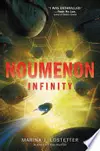
There is lot going on in this second installment of the Noumenon trilogy that covers thousands of years. The story splits into three main parts that will converge in the end. Convoy Seven tasked by Earth to return to the Dyson Sphere (Web) star and finish the completion of the Dyson Sphere and learn how to harness its energy eventually splits in two when a group within the convoy votes to take some of the convoy ships to investigate remnants of the alien race they call the Natare who appeared to have been the last race to work on the Dyson Sphere. Expedition Seven-Point-Five calls itself Noumenon Ultra and heads off on its century's long investigation. Meanwhile the original Convoy Seven over many generations works to complete the Dyson Sphere and will be horrified to discover what happens when the Dyson Sphere is completed and activated. The third part of the story deals with small Convoy Twelve, made up of both clones and non-clones, tasked to stay near Earth's solar system and research finding other subdimensions in order to find ways to speed up space travel. A subdimensional accident destroys some of the ships and sends the rest of the convoy approximately fifteen kiloparsecs from Earth and over one hundred thousand years into the future. Before the survivors run out of supplies a strange alien race they name the Luhng surrounds their convoy with ships and provides them basic help but does not appear to be very interested in interacting with the lost humans. As with the first book the story is character driven and follows the various iterations of clones and non-clones as the countless generations pass. Societal changes and problems as well as other strange occurrences round out this very imaginative story.
There is lot going on in this second installment of the Noumenon trilogy that covers thousands of years. The story splits into three main parts that will converge in the end. Convoy Seven tasked by Earth to return to the Dyson Sphere (Web) star and finish the completion of the Dyson Sphere and learn how to harness its energy eventually splits in two when a group within the convoy votes to take some of the convoy ships to investigate remnants of the alien race they call the Natare who appeared to have been the last race to work on the Dyson Sphere. Expedition Seven-Point-Five calls itself Noumenon Ultra and heads off on its century's long investigation. Meanwhile the original Convoy Seven over many generations works to complete the Dyson Sphere and will be horrified to discover what happens when the Dyson Sphere is completed and activated. The third part of the story deals with small Convoy Twelve, made up of both clones and non-clones, tasked to stay near Earth's solar system and research finding other subdimensions in order to find ways to speed up space travel. A subdimensional accident destroys some of the ships and sends the rest of the convoy approximately fifteen kiloparsecs from Earth and over one hundred thousand years into the future. Before the survivors run out of supplies a strange alien race they name the Luhng surrounds their convoy with ships and provides them basic help but does not appear to be very interested in interacting with the lost humans. As with the first book the story is character driven and follows the various iterations of clones and non-clones as the countless generations pass. Societal changes and problems as well as other strange occurrences round out this very imaginative story.

I was disappointed in this, the final book in the Noumenon trilogy. Science Fiction is always imaginative; however, I thought the author tried to cram too much into the story, to the point it became confusing. There were several variations of humans, several variations of aliens (some from the beginning of the universe). New religions were formed around a clone descendant of a character from the original book who aged and then reverted to a younger state. A baby that hardly aged physically had to wear a mech suit to interact with her peers. A scientist who, through an accident covered in the second book, would disappear for ever-increasing periods into a subdimension was considered an immortal, along with the two mentioned above. Trying to keep straight who was who due to the sheer number of characters was a daunting task, and using pronouns like he/them, she/they (because of gender diversity), I always find very annoying. The timeline of the story takes place over millennia, dipping in and then jumping ahead hundreds or thousands of years to pick up the story thread, hence why there was always a new crop of characters. I find it impossible to give a synopsis of this over-the-top tale, so I'll just say a lot of extraneous material could have been left out, and it probably would have been a more satisfying read.
I was disappointed in this, the final book in the Noumenon trilogy. Science Fiction is always imaginative; however, I thought the author tried to cram too much into the story, to the point it became confusing. There were several variations of humans, several variations of aliens (some from the beginning of the universe). New religions were formed around a clone descendant of a character from the original book who aged and then reverted to a younger state. A baby that hardly aged physically had to wear a mech suit to interact with her peers. A scientist who, through an accident covered in the second book, would disappear for ever-increasing periods into a subdimension was considered an immortal, along with the two mentioned above. Trying to keep straight who was who due to the sheer number of characters was a daunting task, and using pronouns like he/them, she/they (because of gender diversity), I always find very annoying. The timeline of the story takes place over millennia, dipping in and then jumping ahead hundreds or thousands of years to pick up the story thread, hence why there was always a new crop of characters. I find it impossible to give a synopsis of this over-the-top tale, so I'll just say a lot of extraneous material could have been left out, and it probably would have been a more satisfying read.
