
Daren

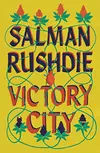
Published in 2023, Rushdie sets up this story as an epic to match the Mahabharata and the Ramayana, but shares it as a (fictional) translation and retelling in this novel - a retelling the chronicle of the founding, life and end of a 14th century city in southern India, its name Bisnaga - a corruption of the word Vijayanagara, or Victory City. Being Salman Rushdie, the story contains magical realism and allegories - many of which, no doubt I didn't pick up on. It is a story partly inspired by the historical, fourteenth-century princess-poet Gangadevi, and the rise of the real historical empire of Vijayanagara (or Karnata Kingdom) in Southern India.
The epic is called Jayaparajaya meaning 'Victory and Defeat', and is made up of twenty-four thousand verses - hence the need for Rushdie to retell it in a simplified form. The author - Pampa Kampana, who on the first page of the novel is 247 years old, witnesses the destruction of Bisnaga, allowing her to compete the epic, seal it in a jar and finally to die.
Pampa Kampana is the constant in the story - as a nine year old the city she lived in lost a war, its soldiers were slaughtered, the women of the village made an enormous fire and in a mass of self immolation, all committed suicide, including her mother, leaving her alone and terrified. Pampa at this point has a divine encounter with Goddess Parvati who speaks through the body of Pampa, and gives her powers - what Parvati says is of course, the storyline of the novel...
"From blood and fire, life and power will be born. In this exact place, a great city will rise, a wonder of the world, and its empire will last more than two centuries. And you will fight to make sure than no more women are burned in this way, and that men start considering women in new ways, and you will live just long enough to witness both your success and failure, to see it all and tell its story, even though once you have finished telling it you will die immediately and nobody will remember you for four hundred and fifty years."
And so from a sack of seeds the city is created, the people with it, their histories created by Pampa, the two brother - retired soldiers, returned to shepherding - who cast the seed, become the first and second kings of Bisnaga, and from there dynasties are created for 247 years.
There is a 'Game of Thrones' element to it, with intrigues, pacts made and broken, expanding empires and warring between states and kingdoms. Each man raised to king brings different rules around the diversity, identity, and multiculturalism, religion, tolerance and war. As expected love and betrayal provide regular twists in the King's court.
There are many intrigues, many allusions to modern day events. The feminist angle is perhaps clumsily written, but is persisted with over generations. There is many nods to India and Pakistan, division on religious lines, to the mixing of religions, imperialism (in the form of invading pink monkeys), the blending of politics and religion, etc etc.
Make no mistake - this book is not the intricate complexity of his earlier works. For me this was almost Rushdie-light. The story flows easily, without a lot of thinking - in fact Rushdie regularly interrupts his narrative to give a paragraph long explanation for something that might be a little complex for the reader to see, or to explain why he chops out a section of narrative, but still wants the reader to know it happened. As other reviewers allude to, perhaps Rushdie doesn't write the female mind very well, and his work of feminism is not where most women would have gone given the power to shape the life of a city.
This was a very easy read, but an enjoyable one, despite its few flaws.
4 stars
Published in 2023, Rushdie sets up this story as an epic to match the Mahabharata and the Ramayana, but shares it as a (fictional) translation and retelling in this novel - a retelling the chronicle of the founding, life and end of a 14th century city in southern India, its name Bisnaga - a corruption of the word Vijayanagara, or Victory City. Being Salman Rushdie, the story contains magical realism and allegories - many of which, no doubt I didn't pick up on. It is a story partly inspired by the historical, fourteenth-century princess-poet Gangadevi, and the rise of the real historical empire of Vijayanagara (or Karnata Kingdom) in Southern India.
The epic is called Jayaparajaya meaning 'Victory and Defeat', and is made up of twenty-four thousand verses - hence the need for Rushdie to retell it in a simplified form. The author - Pampa Kampana, who on the first page of the novel is 247 years old, witnesses the destruction of Bisnaga, allowing her to compete the epic, seal it in a jar and finally to die.
Pampa Kampana is the constant in the story - as a nine year old the city she lived in lost a war, its soldiers were slaughtered, the women of the village made an enormous fire and in a mass of self immolation, all committed suicide, including her mother, leaving her alone and terrified. Pampa at this point has a divine encounter with Goddess Parvati who speaks through the body of Pampa, and gives her powers - what Parvati says is of course, the storyline of the novel...
"From blood and fire, life and power will be born. In this exact place, a great city will rise, a wonder of the world, and its empire will last more than two centuries. And you will fight to make sure than no more women are burned in this way, and that men start considering women in new ways, and you will live just long enough to witness both your success and failure, to see it all and tell its story, even though once you have finished telling it you will die immediately and nobody will remember you for four hundred and fifty years."
And so from a sack of seeds the city is created, the people with it, their histories created by Pampa, the two brother - retired soldiers, returned to shepherding - who cast the seed, become the first and second kings of Bisnaga, and from there dynasties are created for 247 years.
There is a 'Game of Thrones' element to it, with intrigues, pacts made and broken, expanding empires and warring between states and kingdoms. Each man raised to king brings different rules around the diversity, identity, and multiculturalism, religion, tolerance and war. As expected love and betrayal provide regular twists in the King's court.
There are many intrigues, many allusions to modern day events. The feminist angle is perhaps clumsily written, but is persisted with over generations. There is many nods to India and Pakistan, division on religious lines, to the mixing of religions, imperialism (in the form of invading pink monkeys), the blending of politics and religion, etc etc.
Make no mistake - this book is not the intricate complexity of his earlier works. For me this was almost Rushdie-light. The story flows easily, without a lot of thinking - in fact Rushdie regularly interrupts his narrative to give a paragraph long explanation for something that might be a little complex for the reader to see, or to explain why he chops out a section of narrative, but still wants the reader to know it happened. As other reviewers allude to, perhaps Rushdie doesn't write the female mind very well, and his work of feminism is not where most women would have gone given the power to shape the life of a city.
This was a very easy read, but an enjoyable one, despite its few flaws.
4 stars