
Alison


I've always been a fan of NPH (who isn't?) so this one was an easy sell for me. Neil's sense of humour makes this an at times laugh-out-loud read, and the quirkiness of the format meant that I had to go back and live ‘my' life several times to experience it over again. I also ended up reading the entire thing from start to finish just to make sure I didn't miss anything.
Funny man, well-written biography, insider stories of life on Broadway, in Hollywood, and the perils of being a child star. What's not to like?
(Warning: if you're anything like me, you'll end up lost down the YouTube black hole watching NPH videos of Tony and Emmy performances for hours after reading this book.)


So, that moment. You know, THAT moment. Where I was forced to stop, tweet something resembling “?!@^$%#????” to a friend while my mental record screeched to a stop.
I can't decide whether I love it, for being so unexpected and brilliant, or resent it, for making me feel silly for not seeing it coming. But either way, it made the book - and now I'm going to have to go back and re-read the beginning to see how different it seems with a new context.
This story was alternately amusing, touching, pointed, and sad, and is so beautifully written that it just flows from one moment to the next, carrying you along so that you lose track of how much you're reading, how much time is passing. This is one of those rare books that gives me moments where I have to pause, savor a particular sentence or phrase, then move on.
Great story, great writing. I don't know what else I can say. It blew me away and I'm now recommending it to everyone that I know.


I read this book while very sick in hospital, which, oddly enough, worked really well. Something about the combination of secret agents, alternate worlds, monsters, magic, fever dreams and really strong drugs was just perfect.
This book screamed out “read me!” the second I saw it. As a librarian I'm an easy target for anything bookish; as a general sci-fi fan anything to do with alternate worlds was always going to be a winner. Add in a review that called it a cross between Doctor Who and Indiana Jones and it was on like Donkey Kong.
The idea of an inter-dimensional library that collects rare books from multiple universes was great. The characters weren't as well fleshed out as I'd like (the main conflict between the protagonist and her nemesis seemed almost cartoonish) but it wasn't enough to spoil this story for me; the plot rocketed along with lots of magic, fantasy creatures and just enough ‘splosions to keep things interesting, with a smattering of world-building mythology in between developments. This is pure popcorn reading at its best; while the writing isn't the greatest, if you want a story that grabs you and drags you along, this is the book for you.


It's been a while since I've read a book that kept demanding my attention when I had other things I should have been doing; Elantris was very definitely jumping up and down demanding to be read.
I loved this. The world, the mythology, the people and the magic completely captured my imagination and left me wanting more (imagine my disappointment to find out there's no sequel). I'm a sucker for ruined civilisations and lost magics (Robin Hobb's Elderling civilisation is a great example of this), and Sanderson did a great job teasing out the mythology to force the reader to try to work out what was going on. I did have an issue with the idea that it had only been ten years since the fall of the city; I found it hard to accept that all of the knowledge of the city, its people and its magic could be lost so quickly, not to mention the sweeping societal changes that had apparently happened during that time. A generation would have been easier to accept; one hundred years or so would have been perfect.
This was a good read, and one I wish had been longer and a bit more fleshed out. There's so much intriguing information that could have been built on (TELL ME MORE ABOUT THE MAGIC) that I feel like the book could easily have been twice as long. You can tell in places that this is one of Sanderson's earlier works; the writing isn't as polished as it could be, but it's still a great book. Highly recommended.


This book is like a sackful of kittens. Because it's awesome, you see, and sometimes sweet, but there's also a lot of fighting and yowling and pain...
This was a fast and furious read. Sanderson comes out swinging and the pace doesn't relent throughout the entire book. I was expecting a rollicking, fun read, so I was pleasantly surprised to find that there was a whole heaping helping of worldbuilding and mythology development in there as well. Not only do we get more kickass superheroes, we start to find out a bit more of the why and how of them... and the truth behind Calamity.
This book moved this series up from a popcorn/filler read to a must-read for me. I'm very much looking forward to book three...


This was one of those books that I really wanted to like a lot more than I actually did. I can remember how charmed I was by Don and his take on life the first time around; the story seemed sweet, funny, and slightly oddball.
This time around Don's troubles seem a lot more forced. Like last time, Don's unique perspective on life and relationships can find him in a lot of trouble through misunderstanding; unlike the first book, I felt like the problems Don faced were being hammed up for laughs at his expense, resulting in a lot of not-quite-believable situations. Characters behave oddly and nothing quite feels organic; it's as if the slapstick payoff had already been written, and the characters were forced to say and do things that don't quite ring true in order to end up at that point.
This is still a solid book and well worth a read for a bit of light escapism; I suppose I was mostly disappointed by my own expectations, hoping to be charmed all over again by a breath of fresh air like I was the first time around.
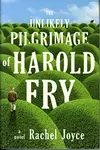


I wanted to like this book a lot more than I ultimately did.
Harold walks out his front door one day to mail a letter to a dying woman with whom he hasn't spoken in many years. Then, without really making a conscious decision to do so, realises he's going to keep walking until he reaches her - across all six hundred miles of British countryside between them. And somehow, he knows his pilgrimage will keep her alive. As he walks Harold's journey slowly morphs into an unexpected attempt save his marriage, face his feelings about his son, and redeem his past mistakes.
It started out with so much promise; Harold's march picked up momentum quickly and carried me along, introducing some interesting background characters along the way (‘everyday person with deep insights and wisdom' trope notwithstanding). The slow unraveling of the mysteries surrounding David, Queenie, and Harold's relationship with Maureen kept me interested for the first half of the novel. But after a while the book became much like Harold's journey itself; it wandered, putting one foot in front of the other in a directionless stumble that seemed to be going nowhere. The endless descriptions of Harold walking began to bog down the story until I felt like I was on a pilgrimage of my own - dragging myself to the end of the book in the hope that the ending would redeem it.
Sadly that didn't happen; by the time I finished I was more than glad to put this book aside. The conclusion was both unsatisfying and overly sentimental, and I was left with the overwhelming impression that the idea behind this book was much stronger than the execution. Four-star premise, two-star writing = 3-star rating. Sorry, Harold.


Given the amount of extremely average dystopian fiction being released these days I approached this book with fairly low expectations. Nothing in the summary seemed particularly new and exciting - it sounded like a strange mixture of [b:Ender's Game 375802 Ender's Game (The Ender Quintet, #1) Orson Scott Card https://d202m5krfqbpi5.cloudfront.net/books/1388177928s/375802.jpg 2422333] + [b:Shades of Grey 2113260 Shades of Grey (Shades of Grey, #1) Jasper Fforde https://d202m5krfqbpi5.cloudfront.net/books/1327563734s/2113260.jpg 2118671] + [b:The Hunger Games 2767052 The Hunger Games (The Hunger Games, #1) Suzanne Collins https://d202m5krfqbpi5.cloudfront.net/books/1358275334s/2767052.jpg 2792775] + [b:Lord of the Flies 7624 Lord of the Flies William Golding https://d202m5krfqbpi5.cloudfront.net/books/1327869409s/7624.jpg 2766512] and I didn't expect to be wowed. I was wrong. So very, very wrong - and so very glad that I was.Red Rising is one of those rare books that takes a whole bunch of elements that you think you've seen a hundred times before yet still manages to weave them into something completely new and captivating. Pierce Brown's simple yet elegant writing brings the protagonist, Darrow, to (harsh, painful) life and I found myself attached to quite a few different characters by the end of the book. This was one of those stories that I could not put down until I fell asleep while trying to read just one more chapter, just one more...I'm eagerly awaiting the sequel, and given that this impressive title is only Pierce Brown's first novel I'll definitely be keeping an eye out for any of his future work.


At first this book seemed like it had all the ingredients to make me fall in love with it: well-written prose, an interesting - if not terribly complicated - mystery, and an intelligent and independent heroine. Unfortunately by the time I'd finished it slid from potentially brilliant to merely good.
The problem is Flavia. I love sassy, snarky, smart heroines as much as the next person, and Flavia's love of chemistry and deductive abilities made her seem like a fabulous cross between Veronica Mars and Violet Baudelaire. Yet at no point could I believe that she was only eleven years old, which was jarring enough to keep pulling me out of the story. The language she uses (both in conversation and while narrating), her actions and her ability to analyse situations and motivations are all far beyond her (supposed) years, notwithstanding her sharp intelligence. I think I would have enjoyed this a lot more had she been written as a sixteen year old. The other characters seemed much more real to me, with Dogger and Flavia's shrill sisters being particular favourites.
Protagonist issues aside, the story moved along at a reasonable pace and the mystery, while a little light, kept me interested until the end. Overall I enjoyed this enough to want to return for more of Flavia's adventures.


On the surface Year One sounds like exactly the sort of book I love. Post-apocalyptic setting? Check. A ragtag band of survivors struggling to scrape together an existence? Check. Even the touch of fantasy in the description made it sound more appealing, bringing to mind books like The Passage. Unfortunately the contents didn't quite match the description on the package.
Year One starts well, building the story of The Doom and the beginning of the end as civilisation crumbles. Tension mounts, and shit starts to get real.
Aaaand then the story takes a sudden and sharp turn, and the survival journey you thought you were on becomes a one-way ride to WTFville.
People are suddenly fairies. Witches. Telepaths. Various paranormal creatures. And they all seem to just accept this without a second thought. (“Yeah, so, I've been a normal human journalist for twenty-something years in a world where magic doesn't exist, but hey I'm now a fairy with amazing powers, so whatever, that's cool.”) The witch characters go from discovering magic is suddenly real to being able to shoot light beams, make force fields, cast ‘cleansing' spells and banish dark magic in the space of a handful of pages, because needing to learn how to do things and develop newfound skills is for chumps.
The characters themselves are disappointingly one-dimensional and lacking in depth. The bad guys are bad because... they're bad? The whole anti-paranormal subplot is done clumsily and seems to exist purely to stick a big ol' These Guys Are So Bad Look At Them They're Like Totally Racist label on the antagonists. It's not quite moustache-twirling territory, but it's close. Add in a Prophesied One and a Marty Stu (in the form of an author who's constantly recognised and whose work is universally adored), and it's trope city.
I'm not a Nora Roberts fan (I don't dislike her either; I've just never read any of her other work) so I didn't have an expectation based on any of her previous books. Nonetheless, the premise sounded amazing and the idea had so much promise that I had high hopes. Unfortunately I ended up disappointed. This book feels like it couldn't quite decide what it wanted to be, and as a result ended up as a muddle of mediocrity. The few interesting threads of plot aren't enough to make up for the other shortcomings.
A very average read.