
Wulf C. Krueger


Dying Truth
Murder at an elite British boarding school where secret societies wield immense influence and control over practically every single pupil—for their entire life. A shady principal, a counselor with secrets, and Joanna Wade, still coming on to Kim.
»The Spades filed silently into the candle room.«
Now imagine Kim “invading” the venerable halls of the school, disrupting the supposed peace and, in her usual manner, penetrating the complex interconnections against all resistance by celebrities, school officials, pupils, and pretty much everyone - with unexpected exceptions…
This is the premise of Dying Truth, Angela Marsons’ eighth instalment in her Kim Stone series and it plays out just as brilliantly as it sounds. I know I also wrote about the previous novel but it’s true for this one as well: It’s the best novel of this series so far.
From the outset, the boarding school provides a gothic, almost claustrophobic atmosphere. With its evocative setting, the novel effortlessly balances a compelling mystery with the intricate dynamics of its key players. The blend of suspense, emotional depth, and psychological insight makes this an absorbing read that stands apart not only as part of the series but also in the crowded crime fiction genre. As such, it can easily be read without prior knowledge of the series as a whole.
Kim Stone herself remains a formidable protagonist whose complexity drives the narrative. I really enjoyed her approach to internal performance reviews: kind, fair, and honest, yet without compromising her innate pragmatism.
Much to Marsons’ credit, though, every single member of Kim’s team really gets to shine.
»Dawson silently applauded the boy’s strength of character in not taking the easy way out of a difficult situation.«
This not only points to the boy’s resilience but mirrors Dawson’s own growth throughout the series. His care and kindness lent a much-needed warmth amidst the darker undercurrents of the story.
In their different ways, everyone does their utmost to solve not only the current crime but also one from the past. While the story impresses with its pace and twists, much of its merit lies in Marsons’ ability to intertwine psychological depth with razor-sharp suspense. Every scene feels calculated yet organic, drawing the reader deeper into the sinister and secretive nature of the boarding school.
A few minor imperfections don’t mar the overall picture. While Tracy Frost, the local journalist, often plays a significant role in the series, here she is sadly underused. I’ve come to enjoy Tracy’s complex character and her interactions with Kim; both aspects are largely neglected here.
Also, interspersed in the story are excerpts from the victim’s diary, immediately followed by the ramblings of the murderer. To me, those parts didn’t really add to the story and the image of the murderer evoked by his commentary was at odds with the character as shown throughout the novel.
The ending, too, felt entirely consistent with Kim’s intricate personality, leaving me both satisfied and eager to explore more of her journey.
Comparatively, “Dying Truth” surpasses earlier entries in the series, such as “Lost Girls”, which I found a bit excessive in its grimness. Here, Marsons masterfully balances tension and emotional resonance, proving once again why—to me—Kim Stone stands out as one of crime fiction’s most intriguing investigators.
Five stars out of five.
Ceterum censeo Putin esse delendam
Originally posted at turing.mailstation.de.
Murder at an elite British boarding school where secret societies wield immense influence and control over practically every single pupil—for their entire life. A shady principal, a counselor with secrets, and Joanna Wade, still coming on to Kim.
»The Spades filed silently into the candle room.«
Now imagine Kim “invading” the venerable halls of the school, disrupting the supposed peace and, in her usual manner, penetrating the complex interconnections against all resistance by celebrities, school officials, pupils, and pretty much everyone - with unexpected exceptions…
This is the premise of Dying Truth, Angela Marsons’ eighth instalment in her Kim Stone series and it plays out just as brilliantly as it sounds. I know I also wrote about the previous novel but it’s true for this one as well: It’s the best novel of this series so far.
From the outset, the boarding school provides a gothic, almost claustrophobic atmosphere. With its evocative setting, the novel effortlessly balances a compelling mystery with the intricate dynamics of its key players. The blend of suspense, emotional depth, and psychological insight makes this an absorbing read that stands apart not only as part of the series but also in the crowded crime fiction genre. As such, it can easily be read without prior knowledge of the series as a whole.
Kim Stone herself remains a formidable protagonist whose complexity drives the narrative. I really enjoyed her approach to internal performance reviews: kind, fair, and honest, yet without compromising her innate pragmatism.
Much to Marsons’ credit, though, every single member of Kim’s team really gets to shine.
»Dawson silently applauded the boy’s strength of character in not taking the easy way out of a difficult situation.«
This not only points to the boy’s resilience but mirrors Dawson’s own growth throughout the series. His care and kindness lent a much-needed warmth amidst the darker undercurrents of the story.
In their different ways, everyone does their utmost to solve not only the current crime but also one from the past. While the story impresses with its pace and twists, much of its merit lies in Marsons’ ability to intertwine psychological depth with razor-sharp suspense. Every scene feels calculated yet organic, drawing the reader deeper into the sinister and secretive nature of the boarding school.
A few minor imperfections don’t mar the overall picture. While Tracy Frost, the local journalist, often plays a significant role in the series, here she is sadly underused. I’ve come to enjoy Tracy’s complex character and her interactions with Kim; both aspects are largely neglected here.
Also, interspersed in the story are excerpts from the victim’s diary, immediately followed by the ramblings of the murderer. To me, those parts didn’t really add to the story and the image of the murderer evoked by his commentary was at odds with the character as shown throughout the novel.
The ending, too, felt entirely consistent with Kim’s intricate personality, leaving me both satisfied and eager to explore more of her journey.
Comparatively, “Dying Truth” surpasses earlier entries in the series, such as “Lost Girls”, which I found a bit excessive in its grimness. Here, Marsons masterfully balances tension and emotional resonance, proving once again why—to me—Kim Stone stands out as one of crime fiction’s most intriguing investigators.
Five stars out of five.
Ceterum censeo Putin esse delendam
Originally posted at turing.mailstation.de.

The Bunk Up
Regressive, Reckless, and Ridiculous: Meet the Worst Book I've Ever Read
In all honesty, this is the worst book I’ve ever read. It’s so backwards-leaning, demented, idiotic, and irresponsible, I wouldn’t be surprised to learn that Long and Sidebottom are actually Trump and Musk respectively.
Daisy is our female protagonist who has just been cheated on by her boyfriend, been fired from her job, and, encouraged by friends, now wants to take a holiday. To give you a first idea of what Daisy is like, let’s examine her thoughts about that:
»My pout returns when I remember she’s right. I have no job to try and take holidays from. I have no boyfriend to seek permission from.«
The male protagonist, Frazer, is by no means better.
»From what I know, Nigel is a prize ass, anyway, and I’m sure no mother could be proud of a son who wears brown corduroys and a feather fucking earring while he sticks toenail clippings to bits of cardboard – all at the same time.«
His behaviour resembles that of a reckless, careless, horny teenager. He doesn’t mind “forgetting” using a condom much and when asked to visit the local pharmacy for the pill after, he refuses because he’s a man…
Daisy's reaction to this is… surprising as well: She starts hopping, “Trying to get it all out. You know, fling it downwards!” as a means of birth control.
Frazer also thinks “pulling out” is a valid method of contraception, and so does Daisy, as she doesn’t even react to it. He also doesn’t mind jumping the next available female despite harbouring very strong feelings for Daisy. To get rid of said woman the morning after, he behaves extremely rudely and insultingly to her.
There’s also a notable side character called Frank. Frank seems to be a middle-aged white male of the “disgusting sexist” variety. Whenever and wherever he sees a woman, he greets her like this:
»Frank is sitting at his spot on the bench, and lifting a hand in greeting to me, he shouts out, “Morning, sugar tits.”«
And this is by far the most “harmless” greeting…
Fittingly, the writing feels cheap and bland, with absolutely no highlights and humour of this type:
»He makes money out of used loo rolls and my life is so shit I need the toilet tissue.«
There’s a lot of sex and I usually don’t complain about smut but the sparse and barren language as well as a complete absence of noticeable, credible desire or at least lust gives it a mechanical, transactional, and sometimes clinical feeling. Let’s take a look at Daisy’s and Frazer’s first “encounter” (abridged):
»“Show me your dick and I’ll sign the piece of paper.”
[...]
“Oh yeah. Okay then. Here goes.”
[...]
He winks at me. “Fine with me. Listen. This is going to sound weird, but can I touch your boob just a little bit?”
[...]
“Okay.”
[...]
“I want to touch it.”
[...]
“You can if you want but then you’ll have to excuse me to go to the loo and know I’m going to think about your body as I beat off. I’ve gone past the point of no return here.”«
This, fellow readers, is how they fall in insta-love. It is also the moment when I started feeling nauseous.
Even though this is more of a novella, there’s still tons of filler material, e. g. Daisy going on a dinner date (a disaster both story- and novel-wise) during which she complains about the size of one of the waiter’s eyes…
»The waiter huffs loudly and shifts from one foot to the other. I’d feel sympathetic for him but he definitely has one eye bigger than the other and looks down right shifty.«
The authors go on, and on, and on to put every single shitty cliché into their novel…
»Shirley reaches out and pats Daisy’s hand. “Aww, darling, you should have said if you’re premenstrual.”«
… to “dumb blondes”...
»Maybe because, a, your dick definitely does NOT taste of lychees like you promised.«
… and great, loving parenting styles…
»Your brother ran away at thirteen when I told him he couldn’t dye his hair pink. He did the same at fourteen when I told him his new earring looked stupid. It was a peacock feather, for God’s sake.«
There’s even blackfacing…
»Kathy and I are dressed in hoodies and jeans. We’ve put the darkest fake tan on our faces and hands so we look a different race altogether from a distance. That’s what we’re going to be all night long.«
This could go on for all of the 260 pages of this irredeemably bad book, one of the very few without any redeeming qualities at all.
There was one moment, though, that made me laugh out loud but, unfortunately, it was unintentionally funny and only serves to show how, uhm, “intellectually challenged” these authors are:
»She then turns over and is out as if someone has put a chlorophyll-filled tissue in her face.«
Dear Andie and D.H., the word you were looking for is “Chloroform” which firmly belongs to the 19th and early 20th century from which your novel’s jokes, ideas about gender, sex, and societal norms also come.
Your verbal diarrhoea is disgusting and solely garners one star out of five because I can’t give none.
Ceterum censeo Putin esse delendam
Originally posted at turing.mailstation.de.
Regressive, Reckless, and Ridiculous: Meet the Worst Book I've Ever Read
In all honesty, this is the worst book I’ve ever read. It’s so backwards-leaning, demented, idiotic, and irresponsible, I wouldn’t be surprised to learn that Long and Sidebottom are actually Trump and Musk respectively.
Daisy is our female protagonist who has just been cheated on by her boyfriend, been fired from her job, and, encouraged by friends, now wants to take a holiday. To give you a first idea of what Daisy is like, let’s examine her thoughts about that:
»My pout returns when I remember she’s right. I have no job to try and take holidays from. I have no boyfriend to seek permission from.«
The male protagonist, Frazer, is by no means better.
»From what I know, Nigel is a prize ass, anyway, and I’m sure no mother could be proud of a son who wears brown corduroys and a feather fucking earring while he sticks toenail clippings to bits of cardboard – all at the same time.«
His behaviour resembles that of a reckless, careless, horny teenager. He doesn’t mind “forgetting” using a condom much and when asked to visit the local pharmacy for the pill after, he refuses because he’s a man…
Daisy's reaction to this is… surprising as well: She starts hopping, “Trying to get it all out. You know, fling it downwards!” as a means of birth control.
Frazer also thinks “pulling out” is a valid method of contraception, and so does Daisy, as she doesn’t even react to it. He also doesn’t mind jumping the next available female despite harbouring very strong feelings for Daisy. To get rid of said woman the morning after, he behaves extremely rudely and insultingly to her.
There’s also a notable side character called Frank. Frank seems to be a middle-aged white male of the “disgusting sexist” variety. Whenever and wherever he sees a woman, he greets her like this:
»Frank is sitting at his spot on the bench, and lifting a hand in greeting to me, he shouts out, “Morning, sugar tits.”«
And this is by far the most “harmless” greeting…
Fittingly, the writing feels cheap and bland, with absolutely no highlights and humour of this type:
»He makes money out of used loo rolls and my life is so shit I need the toilet tissue.«
There’s a lot of sex and I usually don’t complain about smut but the sparse and barren language as well as a complete absence of noticeable, credible desire or at least lust gives it a mechanical, transactional, and sometimes clinical feeling. Let’s take a look at Daisy’s and Frazer’s first “encounter” (abridged):
»“Show me your dick and I’ll sign the piece of paper.”
[...]
“Oh yeah. Okay then. Here goes.”
[...]
He winks at me. “Fine with me. Listen. This is going to sound weird, but can I touch your boob just a little bit?”
[...]
“Okay.”
[...]
“I want to touch it.”
[...]
“You can if you want but then you’ll have to excuse me to go to the loo and know I’m going to think about your body as I beat off. I’ve gone past the point of no return here.”«
This, fellow readers, is how they fall in insta-love. It is also the moment when I started feeling nauseous.
Even though this is more of a novella, there’s still tons of filler material, e. g. Daisy going on a dinner date (a disaster both story- and novel-wise) during which she complains about the size of one of the waiter’s eyes…
»The waiter huffs loudly and shifts from one foot to the other. I’d feel sympathetic for him but he definitely has one eye bigger than the other and looks down right shifty.«
The authors go on, and on, and on to put every single shitty cliché into their novel…
»Shirley reaches out and pats Daisy’s hand. “Aww, darling, you should have said if you’re premenstrual.”«
… to “dumb blondes”...
»Maybe because, a, your dick definitely does NOT taste of lychees like you promised.«
… and great, loving parenting styles…
»Your brother ran away at thirteen when I told him he couldn’t dye his hair pink. He did the same at fourteen when I told him his new earring looked stupid. It was a peacock feather, for God’s sake.«
There’s even blackfacing…
»Kathy and I are dressed in hoodies and jeans. We’ve put the darkest fake tan on our faces and hands so we look a different race altogether from a distance. That’s what we’re going to be all night long.«
This could go on for all of the 260 pages of this irredeemably bad book, one of the very few without any redeeming qualities at all.
There was one moment, though, that made me laugh out loud but, unfortunately, it was unintentionally funny and only serves to show how, uhm, “intellectually challenged” these authors are:
»She then turns over and is out as if someone has put a chlorophyll-filled tissue in her face.«
Dear Andie and D.H., the word you were looking for is “Chloroform” which firmly belongs to the 19th and early 20th century from which your novel’s jokes, ideas about gender, sex, and societal norms also come.
Your verbal diarrhoea is disgusting and solely garners one star out of five because I can’t give none.
Ceterum censeo Putin esse delendam
Originally posted at turing.mailstation.de.
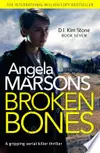
Not as sharp as before, but Kim Stone’s grit keeps me hooked.
Angela Marsons’ “Broken Bones” follows Kim Stone and her tireless team as they delve into a network of crimes that expose the darkest corners of society. While its predecessor left me enthralled, this one felt like a slight step back in terms of sheer suspense, character development, and immediacy of action.
“Broken Bones” deals with issues of desperation, abuse, and exploitation, exploring the ways marginalised people navigate a world indifferent to their suffering. Among the novel’s many strengths, Detective Kim Stone continues to stand out. Her tenacity, resilience, and willingness to challenge perceptions radiate in every chapter.
»He turned to look at her. ‘You’re advising me on positivity?’
‘Oh, the irony,’ she observed.«
The novel also examines the complexity of human behaviour. In a powerful scene, Kim reflects on the limitations of stereotyping:
»’A contradiction, eh?’ Bryant asked.
Kim shook her head. ‘Just a person, Bryant. Full of likes and dislikes, fears and hopes. I’m still waiting to meet the stereotype.’«
Despite these positives, the pacing felt uneven. At points, the plot unfolded methodically, building tension. Yet the resolution lacked the satisfying intricacy I’ve come to expect. Subplots occasionally dipped into predictability, and the shadow of the previous, stronger instalment loomed large. Marsons sets a high bar, and while “Broken Bones” meets it in parts, it falls short of being as impactful as its immediate predecessor.
All in all, I enjoyed “Broken Bones”—its gritty realism, memorable characters, and moments of raw emotion make it a worthy read. However, it wasn’t as consistently enthralling as I’d hoped, and I missed some of the edge that made earlier books exceptional.
Four stars out of five.
Ceterum censeo Putin esse delendam
Originally posted at turing.mailstation.de.
Not as sharp as before, but Kim Stone’s grit keeps me hooked.
Angela Marsons’ “Broken Bones” follows Kim Stone and her tireless team as they delve into a network of crimes that expose the darkest corners of society. While its predecessor left me enthralled, this one felt like a slight step back in terms of sheer suspense, character development, and immediacy of action.
“Broken Bones” deals with issues of desperation, abuse, and exploitation, exploring the ways marginalised people navigate a world indifferent to their suffering. Among the novel’s many strengths, Detective Kim Stone continues to stand out. Her tenacity, resilience, and willingness to challenge perceptions radiate in every chapter.
»He turned to look at her. ‘You’re advising me on positivity?’
‘Oh, the irony,’ she observed.«
The novel also examines the complexity of human behaviour. In a powerful scene, Kim reflects on the limitations of stereotyping:
»’A contradiction, eh?’ Bryant asked.
Kim shook her head. ‘Just a person, Bryant. Full of likes and dislikes, fears and hopes. I’m still waiting to meet the stereotype.’«
Despite these positives, the pacing felt uneven. At points, the plot unfolded methodically, building tension. Yet the resolution lacked the satisfying intricacy I’ve come to expect. Subplots occasionally dipped into predictability, and the shadow of the previous, stronger instalment loomed large. Marsons sets a high bar, and while “Broken Bones” meets it in parts, it falls short of being as impactful as its immediate predecessor.
All in all, I enjoyed “Broken Bones”—its gritty realism, memorable characters, and moments of raw emotion make it a worthy read. However, it wasn’t as consistently enthralling as I’d hoped, and I missed some of the edge that made earlier books exceptional.
Four stars out of five.
Ceterum censeo Putin esse delendam
Originally posted at turing.mailstation.de.


I've followed Angela Marsons' Kim Stone series from the beginning, and "Dead Souls" was, so far, its best instalment.
What sets this entry apart is the fascinating dynamic created by forcing Kim Stone to work alongside her long-standing nemesis, Tom Travis, and his team. This unexpected partnership generates tension throughout the story, while Kim's own team tackles separate cases that eventually interweave.The culmination, involving the abduction of one of Kim's team members, had me perched on the edge of my seat.
Marsons has always excelled at pacing, but here she's outdone herself. The narrative flows with the precision of a well-oiled machine, never feeling rushed yet maintaining a constant sense of urgency. While the subject matter is undeniably dark—dealing with xenophobia, racism, and hate crimes—it doesn't descend into the gratuitous territory that sometimes plagues contemporary crime fiction.
It feels almost eerie to have read this in January 2025, considering a convicted felon, an insurrectionist spared jail and disqualification from office by his election, is about to become president of the USA in less than a week. and his “tech bro” is openly supporting Nazis in Germany and the UK.
Back to fiction, though: The character development continues to impress, with both familiar faces and new additions being rendered in compelling detail. I particularly appreciated how Marsons uses the team's separation to spotlight individual character growth while maintaining the series' distinctive group dynamic.
Comparing this to previous entries in the series, such as "Broken Bones" or "Evil Games", "Dead Souls" shows a marked evolution in both storytelling sophistication and thematic depth.
For readers new to the series, while this book can stand alone, I'd recommend starting from the beginning to fully appreciate the character relationships and their development. However, long-time fans will find this a particularly rewarding entry that pushes beloved characters into new territory while maintaining everything we've come to love about the series.
Five stars out of five.
Ceterum censeo Putin esse delendam
Originally posted at turing.mailstation.de.
I've followed Angela Marsons' Kim Stone series from the beginning, and "Dead Souls" was, so far, its best instalment.
What sets this entry apart is the fascinating dynamic created by forcing Kim Stone to work alongside her long-standing nemesis, Tom Travis, and his team. This unexpected partnership generates tension throughout the story, while Kim's own team tackles separate cases that eventually interweave.The culmination, involving the abduction of one of Kim's team members, had me perched on the edge of my seat.
Marsons has always excelled at pacing, but here she's outdone herself. The narrative flows with the precision of a well-oiled machine, never feeling rushed yet maintaining a constant sense of urgency. While the subject matter is undeniably dark—dealing with xenophobia, racism, and hate crimes—it doesn't descend into the gratuitous territory that sometimes plagues contemporary crime fiction.
It feels almost eerie to have read this in January 2025, considering a convicted felon, an insurrectionist spared jail and disqualification from office by his election, is about to become president of the USA in less than a week. and his “tech bro” is openly supporting Nazis in Germany and the UK.
Back to fiction, though: The character development continues to impress, with both familiar faces and new additions being rendered in compelling detail. I particularly appreciated how Marsons uses the team's separation to spotlight individual character growth while maintaining the series' distinctive group dynamic.
Comparing this to previous entries in the series, such as "Broken Bones" or "Evil Games", "Dead Souls" shows a marked evolution in both storytelling sophistication and thematic depth.
For readers new to the series, while this book can stand alone, I'd recommend starting from the beginning to fully appreciate the character relationships and their development. However, long-time fans will find this a particularly rewarding entry that pushes beloved characters into new territory while maintaining everything we've come to love about the series.
Five stars out of five.
Ceterum censeo Putin esse delendam
Originally posted at turing.mailstation.de.