
nicanical

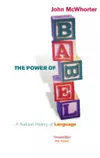
An okay, if dated, primer on historical linguistics. John McWhorter's The Power of Babel presents languages as loose groups of similar dialects, highly malleable, and ever-changing through mechanisms like grammaticalization and rebracketting. This contrasts with the layman's concept of languages as distinct, rigidly codified in writing, only mixing into pidgins and creoles where populations rub up against each other.
The mechanisms of change are fascinating, from sounds to semantics—just the type of stuff I wanted to read about and what I imagined linguistics to be about. So I was surprised to learn, in chapter seven, that these are peripheral topics in linguistics, with most attention and resources going to the Chomskyan study of innate, biological, human language ability:
[T]he linguist who does not display at least token interest in the Chomskyan endeavor is not considered "a linguist linguist" . . . .
(At least, this was the case in the early 2000s when Babel was published—a cursory search didn't clarify whether this is or isn't still the case).
While its contents are interesting, Babel as a composition is poor. There's a sense that the manuscript went through poor or little editing. The latter half is notably tedious: McWhorter veers off on tangents or frets to the reader over the substance and quality of his analogies. Many of his analogies are inaccessible now because they rely on pop culture of the time, and pop culture has expiry dates.
Some parts are simply sloppy. E.g., chapter five where McWhorter discusses "decorative gunk" accumulating in languages over time: he variously refers to it as gunk, bric-a-brac, crud, doodads, barnacles, like he was skipping through a thesaurus—pick one word and stick to it, John.
An okay, if dated, primer on historical linguistics. John McWhorter's The Power of Babel presents languages as loose groups of similar dialects, highly malleable, and ever-changing through mechanisms like grammaticalization and rebracketting. This contrasts with the layman's concept of languages as distinct, rigidly codified in writing, only mixing into pidgins and creoles where populations rub up against each other.
The mechanisms of change are fascinating, from sounds to semantics—just the type of stuff I wanted to read about and what I imagined linguistics to be about. So I was surprised to learn, in chapter seven, that these are peripheral topics in linguistics, with most attention and resources going to the Chomskyan study of innate, biological, human language ability:
[T]he linguist who does not display at least token interest in the Chomskyan endeavor is not considered "a linguist linguist" . . . .
(At least, this was the case in the early 2000s when Babel was published—a cursory search didn't clarify whether this is or isn't still the case).
While its contents are interesting, Babel as a composition is poor. There's a sense that the manuscript went through poor or little editing. The latter half is notably tedious: McWhorter veers off on tangents or frets to the reader over the substance and quality of his analogies. Many of his analogies are inaccessible now because they rely on pop culture of the time, and pop culture has expiry dates.
Some parts are simply sloppy. E.g., chapter five where McWhorter discusses "decorative gunk" accumulating in languages over time: he variously refers to it as gunk, bric-a-brac, crud, doodads, barnacles, like he was skipping through a thesaurus—pick one word and stick to it, John.