
Andre


The title of this book is perfectly fitting for the story Sarah Wynn-Williams recounts, as the subjects seem entirely self-absorbed, prioritizing their own interests above all else. Even the author, who frames her early work at Facebook as an attempt to change the world for the better, cannot fully escape accountability for the monster the platform eventually became—regardless of how minor her personal contribution may have been in the grand scheme. Ultimately, the book’s most compelling takeaway is that strong regulation is paramount for any emerging industry; without it, these entities risk growing into forces that are impossible to tame.


By all accounts, this book should not work. It spans several centuries in just 300 pages, frequently shifting away from its central characters and only referencing them later to tie the narrative together. Yet, this structure highlights Asimov’s brilliance in world-building, resulting in a true masterpiece. In this story, the protagonist is not an individual, but the Foundation itself. Its inception and growth provide all the narrative anchor needed. Even as the characters become mere specks in the passage of time, they perfectly exemplify the core tenet of psychohistory: it can predict the future of a civilization, but never that of an individual.
If I have one critique, it is that the characters navigating the recurring Seldon crises often seem too certain of their path, rarely displaying doubt in their actions. However, perhaps this is the inevitable result of Hari Seldon’s psychohistory—a design where the course set in motion by the Foundation leads to singular outcomes, effectively limiting the agency of those caught within its wake.


Excavations has some deliciously dry humor that's the great gem within this book. Myers' characters are well-developed, even if sometimes too stuck in their own idiosyncrasies, which can make them feel one-sided. The story itself is interesting, a workplace comedy that centers around archaeology and feminism. However, the first half of the book is somewhat slow, and even when the narrative picks up steam, it can still feel sluggish, surprisingly ending as abruptly as an earthquake.


This book is as enlightening as it is infuriating. To be clear, I loved this book. It's a clear and precise account of what the tech monopolies have been doing to destroy their products in the search for constant growth. What's infuriating is seeing laid out so clearly the playbook basically every company uses to screw all of their consumers.
On a better note, I'm very happy to have discovered Libro.fm through this book, and I'm a subscriber now!


I have to start by admitting that, likely due to my geographical location, I was unaware of the extent to which tuberculosis remains a prevalent global issue. This book provides an important and deeply moving account of both the history of the disease and its current impact in developing nations. It's astonishing to witness its transformation from a romanticized illness to another tool used to marginalize vulnerable populations. Combined with John Green's impeccable writing style, there's not much to dislike about this book.


I always enjoy Ward's writing, and her horror is as soft as it is disturbing. This story smartly uses the classic Peter Pan tale (a scary story itself) to set the foundation for this book. Even though the parallels are easy to draw, this is definitely not a retelling but its own intentional story. As is usual for Ward, she delivers an interesting twist that is not forceful or overly obvious. However, I did have some trouble connecting with the protagonist, not necessarily because I didn't care for her motivations, but mostly because I found some of her actions frustrating (even though I would have likely done the same).


Similar to the first book, Carl's Doomsday Scenario is a pleasure to read. Unlike the first book, this one incorporates quests that serve to advance the storyline while also expanding the overall narrative.
Carl and Donut's relationship keeps growing, and it's impossible not to love them (especially on THAT moment towards the end).


With The Return of the King, Tolkien successfully concludes his magnum opus with a lengthy yet deeply satisfying finale. While I typically am not drawn to overtly honorable characters, Tolkien's lore is so well-developed, and the story's stakes so compellingly presented, that I couldn't help but root for the heroes. It's particularly striking to recognize, after reading this and the preceding volumes, the profound influence Tolkien has had on the fantasy genre, extending far beyond literature.


This is a simple yet thorough explanation of the current world economy, perfect for someone looking for a 101 crash course. Scanlon is very adept at simplifying complex concepts using a Gen Z sensibility and, often, jargon.
However, the conclusion falls prey to the usual platitudes of the genre, especially the adoption of the Abundance model to solve the world's problems, leaving me with a feeling that the book's strengths are in explaining how the world currently works, but not how it can be made better.
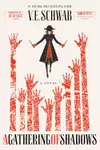


Schwab is masterful at giving us a glimpse of a complex world through the eyes and feelings of a limited set of characters, and this book is a great example of that. Her writing is impeccable and easy to follow, and her characters grow on you as you read.
In this book, however, the focus is too limited to the characters' immediate thoughts. It's easy to understand their motivation, but I was left wanting to learn more about the world, its politics, and its ramifications. By taking the first half to get to the Elemental Games and the second half to go through them, Schwab does a great job at crafting her characters in detriment to world-building and impactful events. This makes the book not be a strong standalone entry, but an interesting setup for the final book in the series.


Contains spoilers
Even though the podcast within the book serves as an interesting plot device, the book shines in its portrayal of Lucy. She is not your usual victim who simply suffers at the hands of others. She does suffer a lot throughout the story, but she is not the picture-perfect damsel in distress. Lucy is flawed, sarcastic to her own detriment, and made plenty of mistakes in her life.
The twist at the end is not completely impossible to figure out as it's easy to assume all suspects are too obvious not to be red herrings, but the final sequence as Lucy confronts the real killer is very surprising.


Contains spoilers
Matt Dinniman’s prose is a pleasure to read: simple, clear, and easy to sink into, especially given how many worldbuilding rules this first book has to lay down. Even as a regular (C)RPG player who’s used to the usual jargon and systems, I never felt bored by the setup; the mechanics are introduced smoothly and stay entertaining instead of feeling like homework.
I also went in a little worried that Carl and Donut’s relationship would grate on me, since I expected them to clash more than connect. But that concern faded fast. They’re definitely different people and they do butt heads, yet their affection for each other is never in doubt. It doesn’t feel like a bond that forms during the crawl, it’s something that clearly comes from years of shared history.
Overall, this is a strong debut and a great entry point for the series. By the end, I was more than ready to keep going and see just how much deeper the crawl gets.


Lindsay Ellis writing is easy to follow, but not overly simplistic or paternalistic. As a longtime fan of her video essays (let's just say that and avoid using the y-word) this does not come as a surprise. Taking an overall sentiment borrowed from YA novels of yesteryear, Axiom's End marks a great debut and sets up an interesting universe for the following sequels. The book is very successful in creating an original first contact story by using a WikiLeaks style scandal, which is both timely and realistic.
Several reviews insist in comparing this story to Arrival, but that is only true very superficially. Even though language takes on an important role throughout the entire book (which is almost always a plus) it is in no way the same as in Arrival. In Axiom's End, the main character (Cora) is in no way an expert in linguistics and her role ends up being mostly of a passive character, except for a few situations in which she actually has to make a decision.
This ends up being one of the only problems with the book. Even though Cora is a strong character, most of the plot happens with her presence but without her input. Her only role is to parrot the main alien character (or should I say romantic interest?) and the story justifies her importance with the fact that she provides context and editorial choices when translating what is said to her to her fellow humans. However, it is undeniable that most people would be able to do the same if given the opportunity. It is certain, however, that when needed she can save an alien by carrying it for miles or grabbing a shovel and going to town on a bird-machine-reptile-looking villain.


“You” usefully tells its story using the second person to put the reader inside the story. Even though it takes a few pages to get used to it, the easy flow Benoit's writing (proper for YA novels) helps the reader get used to it quickly. The ending is somewhat predictable, even though it surprises both the main character and his antagonist, but the last dozen pages do a good job preparing the reader for the inevitable.


This 3 phase model presented by Downs is a comprehensive look at the life of every gay man coming from a middle/high class background. His breakdown of each stage a gay man goes through is an important dissection that has a great potential to help his readers avoid self-destructive behaviours.
Gay man coming from lower classes will have more difficulty to view themselves in the stories recounted in this book. However, some intersectionality might be found between their lives and the stories shared by Downs.
Stylistically, Downs writing tends to be circular at times, with the same ideas being stated repeatedly within or throughout chapters. However, the reading flow is not impaired by this.