
J

This is another book that's ultimately on bias, and in terms of the research there's a good bit of overlap with Kahneman, but the presentation is different. He really focuses on the economics and the underlying "rational actor" assumption the entire field was built on for decades, and how he used our growing understanding of humans as inherently irrational to help completely change the field. The standard is no longer blindly assuming a perfectly rational person with perfect information acting perfectly in his/her own interest. Instead, the priority is looking at patterns of real behavior in real world situations, and how to apply that knowledge to inform decisions.
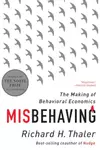
This is another book that's ultimately on bias, and in terms of the research there's a good bit of overlap with Kahneman, but the presentation is different. He really focuses on the economics and the underlying "rational actor" assumption the entire field was built on for decades, and how he used our growing understanding of humans as inherently irrational to help completely change the field. The standard is no longer blindly assuming a perfectly rational person with perfect information acting perfectly in his/her own interest. Instead, the priority is looking at patterns of real behavior in real world situations, and how to apply that knowledge to inform decisions.


Added to listIntelligencewith 69 books.


This is a little different than I expected, and is a little goofy format-wise, because it has some fairly dense cognitive science and music theory that are probably better suited to a text you pore over, but the audio format is enhanced by concrete examples of some of the concepts covered.
But either way, once it gets the preliminaries out of the way, it uses music as a very useful lens into perception more broadly, emotion, how we structure ideas, and how we learn and develop skills. Other books may cover portions he covers in more depth (his mention of Anders Ericsson's research makes me really want to give Peak another read), but it is a nice broad overview of a number of different concepts, as well as some insights of what elements different musicians are playing with to create their signature music. I definitely enjoyed the read and am looking forward to adding a physical copy to my shelf to re-explore in the future.
This is a little different than I expected, and is a little goofy format-wise, because it has some fairly dense cognitive science and music theory that are probably better suited to a text you pore over, but the audio format is enhanced by concrete examples of some of the concepts covered.
But either way, once it gets the preliminaries out of the way, it uses music as a very useful lens into perception more broadly, emotion, how we structure ideas, and how we learn and develop skills. Other books may cover portions he covers in more depth (his mention of Anders Ericsson's research makes me really want to give Peak another read), but it is a nice broad overview of a number of different concepts, as well as some insights of what elements different musicians are playing with to create their signature music. I definitely enjoyed the read and am looking forward to adding a physical copy to my shelf to re-explore in the future.


