
Kim Miller


The Earth and its space force has been destroyed by an alien empire. Only a few space crew are left, scattered into neighbouring star systems. John is a washed up commander living in a back alley and addicted to the local narcotic. Suddenly a car pulls up, the door swings upwards, and some guy says, "Get in the car, Marty. We're going on an adventure." OK, kidding. An old police car pulls up and a guy in dark glasses says, "We're putting the band back together." OK, then, not that either.
An old crew member pulls John out of the alley and cleans him up, then they round up the old crew. Somebody wants a bunch of mercenaries for quick hits against the empire. And the draw card? There's a bunch of woman who escaped Earth and need rescuing. "I'll tell you where they are when you've done some damage to the empire."
After too long spent telling us about anti-gravity drives and null-space drives and the body conformation of aliens etc the book develops into a shoot-em-up rampage reminiscent of an old cowboy movie on Saturday afternoon. The final quarter of the book has some really imaginative tech wizardry that makes the slow first half bearable.
Oh yeah, the author is irritatingly keen on the word 'whatnot'. Obviously not one of those corner shelf stands for aspidistras.
The Earth and its space force has been destroyed by an alien empire. Only a few space crew are left, scattered into neighbouring star systems. John is a washed up commander living in a back alley and addicted to the local narcotic. Suddenly a car pulls up, the door swings upwards, and some guy says, "Get in the car, Marty. We're going on an adventure." OK, kidding. An old police car pulls up and a guy in dark glasses says, "We're putting the band back together." OK, then, not that either.
An old crew member pulls John out of the alley and cleans him up, then they round up the old crew. Somebody wants a bunch of mercenaries for quick hits against the empire. And the draw card? There's a bunch of woman who escaped Earth and need rescuing. "I'll tell you where they are when you've done some damage to the empire."
After too long spent telling us about anti-gravity drives and null-space drives and the body conformation of aliens etc the book develops into a shoot-em-up rampage reminiscent of an old cowboy movie on Saturday afternoon. The final quarter of the book has some really imaginative tech wizardry that makes the slow first half bearable.
Oh yeah, the author is irritatingly keen on the word 'whatnot'. Obviously not one of those corner shelf stands for aspidistras.

This is book 2 of the Bobiverse.
In Bk1 Bob was cryofrozen and awoke to find his mind has been scanned and he's now in a computer. He gets put into a spaceship as its controlling AI and he sets out into the unknown.
Bk 2 sees him as merely the first of many replications, all Bobs, who are flying spaceships around the close galaxy regions. Any Bob can duplicate himself and his ship. New Bobs take a different name, Bob has become a generic type. In this book there are first contact stories, human colonies on other planets, and some serious battles. The chapters are short and bounce around the various planets with different narrators, each with a different name but all with the Bob voice. The first half of the book is a bit of a travelogue and it takes a while for higher stakes to build up.
Cliffhanger warning - it left me wanting to read Bk 3.
This is book 2 of the Bobiverse.
In Bk1 Bob was cryofrozen and awoke to find his mind has been scanned and he's now in a computer. He gets put into a spaceship as its controlling AI and he sets out into the unknown.
Bk 2 sees him as merely the first of many replications, all Bobs, who are flying spaceships around the close galaxy regions. Any Bob can duplicate himself and his ship. New Bobs take a different name, Bob has become a generic type. In this book there are first contact stories, human colonies on other planets, and some serious battles. The chapters are short and bounce around the various planets with different narrators, each with a different name but all with the Bob voice. The first half of the book is a bit of a travelogue and it takes a while for higher stakes to build up.
Cliffhanger warning - it left me wanting to read Bk 3.

George Orr (try to say that without thinking of George Orwell) is having dreams. Trouble is, they are coming true and retro-actively changing reality and history. Only George remembers the previous history and knows that it has been radically changed. He tries to drug himself into dreamlessness but ends up in drug therapy with a psychiatrist dream researcher who sees an opportunity to gain power. But as the power hungry psychiatrist hypnotises George into dreaming certain events, the dreams are not so controllable and become increasingly dangerous in a 'be careful what you wish for' kind of way.
The book is a rush of alternate histories that leave George scrambling to remember what is the current reality and what has changed. It's like 'The First Fifteen Lives of Harry August' except that Harry has some control over his various histories. And in each book they meet the woman to whom they were married in a different stream/life and have to decide how to relate to her.
George Orr (try to say that without thinking of George Orwell) is having dreams. Trouble is, they are coming true and retro-actively changing reality and history. Only George remembers the previous history and knows that it has been radically changed. He tries to drug himself into dreamlessness but ends up in drug therapy with a psychiatrist dream researcher who sees an opportunity to gain power. But as the power hungry psychiatrist hypnotises George into dreaming certain events, the dreams are not so controllable and become increasingly dangerous in a 'be careful what you wish for' kind of way.
The book is a rush of alternate histories that leave George scrambling to remember what is the current reality and what has changed. It's like 'The First Fifteen Lives of Harry August' except that Harry has some control over his various histories. And in each book they meet the woman to whom they were married in a different stream/life and have to decide how to relate to her.

What a standout book. I loved it.
Harry August was born on 1st of January 1919 in the women's rest room of a railway station in the north of England. He lived an unremarkable life and died age 70. Whereupon he was born on 1st of January 1919 in the same women's rest room. Three years later he started to get memories of his first life and by age 6 he remembered everything. Speaking of such things won him no friends and he was 'put away' in an asylum where he died, whereupon he was born on 1st of January 1919 in the women's rest room of a railway station in the north of England. But this time young Harry knew not to speak of remembering each of his earlier lives.
So what would you do if you kept on being born into the same place and remembered everything from all your past lives with the foreknowledge to make better/different decisions? Kill Hitler before you turned 20? (spoiler: he didn't) It's a time travel story with a difference. And a totally captivating read of friendship, deception and betrayal.
What a standout book. I loved it.
Harry August was born on 1st of January 1919 in the women's rest room of a railway station in the north of England. He lived an unremarkable life and died age 70. Whereupon he was born on 1st of January 1919 in the same women's rest room. Three years later he started to get memories of his first life and by age 6 he remembered everything. Speaking of such things won him no friends and he was 'put away' in an asylum where he died, whereupon he was born on 1st of January 1919 in the women's rest room of a railway station in the north of England. But this time young Harry knew not to speak of remembering each of his earlier lives.
So what would you do if you kept on being born into the same place and remembered everything from all your past lives with the foreknowledge to make better/different decisions? Kill Hitler before you turned 20? (spoiler: he didn't) It's a time travel story with a difference. And a totally captivating read of friendship, deception and betrayal.

Book 2 of the Firefall duo. It continued the wild ride of Blindshight with another weird bunch of characters, but a different spaceship on a different journey.
This time the ship is heading to a facility close to the sun. Among the different cast of characters we slowly find out how they are linked to the crew of the first book, and how the aliens of Bk 1 have somehow migrated to story 2. And it's not all good. In the first book Watts was exploring concepts of intelligence vs self awareness. In the second book he explores issues of free will vs whatever the alternatives are. His background is as a marine research biologist and this book closes with several essays on the scientific analysis of his weird characters and story elements, citing several hundred academic journals and articles in the process. So just as my mind was reeling from the close of the story itself I found myself in an academic treatise whirlwind where he seems to say, "See, I told you it was possible."
And on a completely different note. He minimally mentions the time when he flushed his mouth with a cocktail of marine animal and plant DNA just before a swab being taken by some American govt. agency. Now that's a story I want to know more about. :)
Book 2 of the Firefall duo. It continued the wild ride of Blindshight with another weird bunch of characters, but a different spaceship on a different journey.
This time the ship is heading to a facility close to the sun. Among the different cast of characters we slowly find out how they are linked to the crew of the first book, and how the aliens of Bk 1 have somehow migrated to story 2. And it's not all good. In the first book Watts was exploring concepts of intelligence vs self awareness. In the second book he explores issues of free will vs whatever the alternatives are. His background is as a marine research biologist and this book closes with several essays on the scientific analysis of his weird characters and story elements, citing several hundred academic journals and articles in the process. So just as my mind was reeling from the close of the story itself I found myself in an academic treatise whirlwind where he seems to say, "See, I told you it was possible."
And on a completely different note. He minimally mentions the time when he flushed his mouth with a cocktail of marine animal and plant DNA just before a swab being taken by some American govt. agency. Now that's a story I want to know more about. :)

Book 1 in the Firefall series. A far future spaceship ride with rollercoaster energy.
Siri Keeting has severe epilepsy as a child. He undergoes surgery that removes one hemisphere of his brain to control the seizures. Many years later he crews on a spaceship as an observer/reporter because his unique brain function means he can stay emotionally distant from unexpected strange events. And those unexpected events keep piling up. The crew are all augmented in some way, as Siri has also been (after all he's got half a skull they can put stuff into), The ship's captain is inbuilt AI, the nominal commander is a resurrected vampire (so able to make harsh decisions), the linguist has four people's swapable intelligences in her brain, another crew member is in love with one of her personalities, and then there's some rather dangerous aliens. Perhaps I should have mentioned them earlier. Watts increasingly focuses in on what it means to have intelligence vs self awareness. The pace of the action speeds up as the story progresses into a frightening conflict, as does Watts' demands on the reader as his arguments deepen.
One caution. I got about fifty pages into the book and had to look up the Wiki page to sort out who these characters were. The writing is very dense and the people tend to get a bit submerged.
Book 1 in the Firefall series. A far future spaceship ride with rollercoaster energy.
Siri Keeting has severe epilepsy as a child. He undergoes surgery that removes one hemisphere of his brain to control the seizures. Many years later he crews on a spaceship as an observer/reporter because his unique brain function means he can stay emotionally distant from unexpected strange events. And those unexpected events keep piling up. The crew are all augmented in some way, as Siri has also been (after all he's got half a skull they can put stuff into), The ship's captain is inbuilt AI, the nominal commander is a resurrected vampire (so able to make harsh decisions), the linguist has four people's swapable intelligences in her brain, another crew member is in love with one of her personalities, and then there's some rather dangerous aliens. Perhaps I should have mentioned them earlier. Watts increasingly focuses in on what it means to have intelligence vs self awareness. The pace of the action speeds up as the story progresses into a frightening conflict, as does Watts' demands on the reader as his arguments deepen.
One caution. I got about fifty pages into the book and had to look up the Wiki page to sort out who these characters were. The writing is very dense and the people tend to get a bit submerged.
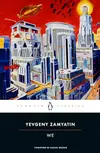
A not too distant future dystopia where everything is made of glass, even the walls between rooms and units, so everything is constantly under surveillance. People walk to work in ordered four-abreast columns, relationships are allowed by the hour through application and permission slips, it's the full catastrophe. D-503 is the lead engineer of a rocket ship (also glass) designed to take the world order into space but he's worried. The concept of the square root of minus one, the foundation of imaginary numbers, occupies his mind. And imagination is outlawed.
This is the novel that Orwell says is the foundation of his 1984. I read the translation by Mirra Ginsburg which is said to have the best rendering of Zamyatin's sardonic humour. I've had to put this review under a different translator as the Ginsburg one isn't listed by the site - and it won't accept me trying to add it.
A not too distant future dystopia where everything is made of glass, even the walls between rooms and units, so everything is constantly under surveillance. People walk to work in ordered four-abreast columns, relationships are allowed by the hour through application and permission slips, it's the full catastrophe. D-503 is the lead engineer of a rocket ship (also glass) designed to take the world order into space but he's worried. The concept of the square root of minus one, the foundation of imaginary numbers, occupies his mind. And imagination is outlawed.
This is the novel that Orwell says is the foundation of his 1984. I read the translation by Mirra Ginsburg which is said to have the best rendering of Zamyatin's sardonic humour. I've had to put this review under a different translator as the Ginsburg one isn't listed by the site - and it won't accept me trying to add it.

This is a bit of a romp as Dennis Taylor serves up some serious fun.
Bob is a successful software and systems engineer. He sells his company for a gazillion bucks, signs into a cryo company to have his body frozen for future revival in the case of his death, and looks forward to a life of luxury and leisure. That afternoon he gets fatally run over at a pedestrian crossing.
Spoiler-free gap here.
Much much later Bob's mind has been uploaded into the control system of a space ship exploring the universe. The ship has replicator machines and can duplicate itself, including Bob. So he makes a bunch more spaceships, each of them controlled by another Bob. It's the interaction of the Bobs where things become funny. Imagine identical twins in a pub, except more of them.
This is a bit of a romp as Dennis Taylor serves up some serious fun.
Bob is a successful software and systems engineer. He sells his company for a gazillion bucks, signs into a cryo company to have his body frozen for future revival in the case of his death, and looks forward to a life of luxury and leisure. That afternoon he gets fatally run over at a pedestrian crossing.
Spoiler-free gap here.
Much much later Bob's mind has been uploaded into the control system of a space ship exploring the universe. The ship has replicator machines and can duplicate itself, including Bob. So he makes a bunch more spaceships, each of them controlled by another Bob. It's the interaction of the Bobs where things become funny. Imagine identical twins in a pub, except more of them.

I've read Le Guin before and love her stuff. This one is a standout for the multi-dimensional themes she explores.
A far future human visits a planet where the people are ambigendered, and being both (and interchangeably) male and female, reproduction means that either one of a couple can become pregnant each time. Added to the mix are the two main countries where one is a monarchy with a paranoid king and psychopath regent and the other is a totalitarian bureaucracy where various factions fight for power. Le Guin explores a slew of binary issues, political intrigue, sexuality and social relationships, religious enlightenment vs taoist philosophy, and what does 'alien' mean?
I've read Le Guin before and love her stuff. This one is a standout for the multi-dimensional themes she explores.
A far future human visits a planet where the people are ambigendered, and being both (and interchangeably) male and female, reproduction means that either one of a couple can become pregnant each time. Added to the mix are the two main countries where one is a monarchy with a paranoid king and psychopath regent and the other is a totalitarian bureaucracy where various factions fight for power. Le Guin explores a slew of binary issues, political intrigue, sexuality and social relationships, religious enlightenment vs taoist philosophy, and what does 'alien' mean?

Three novellas that tie together as one story.
1. Distant twin worlds are colonised by humans. The narrator is a boy growing up on one world in a strange house that turns out to be a high-end brothel run by his scientist father. They are visited by an anthropologist from Earth named Marsh who is researching the view that one of the worlds was populated by shape shifters who killed the colonisers and took their identities.
2. A dreamlike hypnotic tale of the original inhabitants told by Marsh as if by a shaman. There are conflicts between marsh-people, hill-people, and shadow-people who may or may not even be corporeal beings. Hidden in the story is the coming of the colonisers.
3. A Kafkaesque story of Marsh being arrested, imprisoned, and questioned by an unidentified bureaucrat. The story switches without notice between direct narration, transcripts of recorded interrogations, and Marsh's notes from his journey to find the original inhabitants. His notes, by the way, have fallen apart and are picked up and read by the interrogator in any order. Luckily for us, there is one notebook intact.
The book ends abruptly and without explanation. Wolfe has scattered bits of information throughout the whole but the reader won't even see them until realising the meaning of the final few paragraphs. It's like putting together a jigsaw puzzle where all the hidden stuff is on the wrong side of each piece. A bit like Kafka's The Trial, you could read the stories in any order and be just as mystified until you sit and piece it all together afterwards.
Three novellas that tie together as one story.
1. Distant twin worlds are colonised by humans. The narrator is a boy growing up on one world in a strange house that turns out to be a high-end brothel run by his scientist father. They are visited by an anthropologist from Earth named Marsh who is researching the view that one of the worlds was populated by shape shifters who killed the colonisers and took their identities.
2. A dreamlike hypnotic tale of the original inhabitants told by Marsh as if by a shaman. There are conflicts between marsh-people, hill-people, and shadow-people who may or may not even be corporeal beings. Hidden in the story is the coming of the colonisers.
3. A Kafkaesque story of Marsh being arrested, imprisoned, and questioned by an unidentified bureaucrat. The story switches without notice between direct narration, transcripts of recorded interrogations, and Marsh's notes from his journey to find the original inhabitants. His notes, by the way, have fallen apart and are picked up and read by the interrogator in any order. Luckily for us, there is one notebook intact.
The book ends abruptly and without explanation. Wolfe has scattered bits of information throughout the whole but the reader won't even see them until realising the meaning of the final few paragraphs. It's like putting together a jigsaw puzzle where all the hidden stuff is on the wrong side of each piece. A bit like Kafka's The Trial, you could read the stories in any order and be just as mystified until you sit and piece it all together afterwards.

I'd seen the movie years ago but it didn't send me to the book. 'Hollywood cute kid' gets manipulated into turning gaming skills into making war. Ends up causing mass genocide of alien race when he thought he was on a practice gaming session. Han Solo / Indian Jones (Harrison Ford) was the bad guy this time. The end.
Somebody recommended the book and it was a much better story than the movie. Instead of the apologist piece for American military and imperialism of the movie it explored the implications of brutalising people to make them into fighting machines. Ender's relationship with his brother (psychopath) and sister (empath) ran through the whole story and formed the foundation of Orson Scott Card blurring the boundaries between compassion and fascism.
This was a one-day stop-for-meals read and carried itself well.
I'd seen the movie years ago but it didn't send me to the book. 'Hollywood cute kid' gets manipulated into turning gaming skills into making war. Ends up causing mass genocide of alien race when he thought he was on a practice gaming session. Han Solo / Indian Jones (Harrison Ford) was the bad guy this time. The end.
Somebody recommended the book and it was a much better story than the movie. Instead of the apologist piece for American military and imperialism of the movie it explored the implications of brutalising people to make them into fighting machines. Ender's relationship with his brother (psychopath) and sister (empath) ran through the whole story and formed the foundation of Orson Scott Card blurring the boundaries between compassion and fascism.
This was a one-day stop-for-meals read and carried itself well.

A barbarian turns up in a medieval tavern, gets into a fight with the locals, things turn bad etc.
This book has a weird history. It was written in 1970 by 16 year old Jim, who was a member of a zine club in his town. The zine was a stapled together collection of writings from members and produced on those old wax masters that we'd type on. The master was put onto the belt of the duplicator and the machine wound by hand. The technology of the day. The writing was all over the place with Jim using fancy words, often spelled badly and used incorrectly for the context.
The editor of the zine sent a copy to a zine friend in another city, not realising that the back page had come adrift from the staples. That guy read some of it at a zine conference, people fell about laughing, especially as the story had no ending page. So they passed the zine around the circle, each person reading until they started laughing, then the next person etc. Over the years it got copied and copied (still no last page) and became a zine conference comedy thing to read it like this. It got tagged with 'Is this the worst fantasy story ever written?'
Jim heard about it and was upset that he was being mocked for something he'd written as a youngster and said he'd never write anything ever again. Jim died in his forties. Then somebody found an original copy of the zine with the back page intact. Over time the story found its way onto websites for downloading. Taff.org.uk has the full ebook with notes on its history.
I feel for Jim. Had his original story received some simple editing before circulating as it did it would not have been the subject of ridicule that it became. And perhaps Jim could have written more.
A barbarian turns up in a medieval tavern, gets into a fight with the locals, things turn bad etc.
This book has a weird history. It was written in 1970 by 16 year old Jim, who was a member of a zine club in his town. The zine was a stapled together collection of writings from members and produced on those old wax masters that we'd type on. The master was put onto the belt of the duplicator and the machine wound by hand. The technology of the day. The writing was all over the place with Jim using fancy words, often spelled badly and used incorrectly for the context.
The editor of the zine sent a copy to a zine friend in another city, not realising that the back page had come adrift from the staples. That guy read some of it at a zine conference, people fell about laughing, especially as the story had no ending page. So they passed the zine around the circle, each person reading until they started laughing, then the next person etc. Over the years it got copied and copied (still no last page) and became a zine conference comedy thing to read it like this. It got tagged with 'Is this the worst fantasy story ever written?'
Jim heard about it and was upset that he was being mocked for something he'd written as a youngster and said he'd never write anything ever again. Jim died in his forties. Then somebody found an original copy of the zine with the back page intact. Over time the story found its way onto websites for downloading. Taff.org.uk has the full ebook with notes on its history.
I feel for Jim. Had his original story received some simple editing before circulating as it did it would not have been the subject of ridicule that it became. And perhaps Jim could have written more.

I read this as a bit of a break from the SciFi I normally read.
A stoic primer on how to manage a good life. Lots of insight into the mind of a Roman Emperor as he balances the power of his position with being human. It's not a book to read and put down, but to have on hand to dip into in quieter moments of daily life. Of course it contains some good stuff, that's what made it a classic. But I'm not usually much of a reader of self-help books so it didn't hit me as deep as it does others.
I read this as a bit of a break from the SciFi I normally read.
A stoic primer on how to manage a good life. Lots of insight into the mind of a Roman Emperor as he balances the power of his position with being human. It's not a book to read and put down, but to have on hand to dip into in quieter moments of daily life. Of course it contains some good stuff, that's what made it a classic. But I'm not usually much of a reader of self-help books so it didn't hit me as deep as it does others.

This is a short story compilation that scatters through his Xeelee Sequence novels and stories. His stuff is always a good read although this one loses its grip at times with characters and story lines not being as sharp as expected. However, covering about five billions years of cosmic history is no mean feat.
This is a short story compilation that scatters through his Xeelee Sequence novels and stories. His stuff is always a good read although this one loses its grip at times with characters and story lines not being as sharp as expected. However, covering about five billions years of cosmic history is no mean feat.

I saw the Tarkovsky movie many years ago but his movies are so slow and dreamlike it was difficult getting into the story. I chased up the book but the English translation had come from the French translation and everybody bagged it out. This direct to English translationby Bill Johnston came out in 2011 and this was the one i read. Now I've got to go back to the movie, I'm sure it will make more sense.
It's a book that deals with mankind's inability to handle failure, and with no hero in sight.
I saw the Tarkovsky movie many years ago but his movies are so slow and dreamlike it was difficult getting into the story. I chased up the book but the English translation had come from the French translation and everybody bagged it out. This direct to English translationby Bill Johnston came out in 2011 and this was the one i read. Now I've got to go back to the movie, I'm sure it will make more sense.
It's a book that deals with mankind's inability to handle failure, and with no hero in sight.

This is the coda novel of the series, 'Book of the New Sun'.
It is mostly SciFi content but skinned in the fantasy world of the protagonist Severian. In this final book he is doing crazy time jumps back into events set through the first four books, and some of the strange elements of the original story start to find explanation. The whole thing demands concentration as it's easy for important things so slip by. On the other hand, I was sometimes scratching my head to remember the characters that appear in the final book from their original settings. And when I did remember them I realised that much of the story is hidden by Wolfe's technique of hinting at things as if he wants to have the last laugh, "Ha! I knew you would not get that bit." He's an evil genius author.
This is the coda novel of the series, 'Book of the New Sun'.
It is mostly SciFi content but skinned in the fantasy world of the protagonist Severian. In this final book he is doing crazy time jumps back into events set through the first four books, and some of the strange elements of the original story start to find explanation. The whole thing demands concentration as it's easy for important things so slip by. On the other hand, I was sometimes scratching my head to remember the characters that appear in the final book from their original settings. And when I did remember them I realised that much of the story is hidden by Wolfe's technique of hinting at things as if he wants to have the last laugh, "Ha! I knew you would not get that bit." He's an evil genius author.

Book 4 of Wolfe's 'Book of the New Sun' series
What a crazy ride this was. Gene Wolfe started out with a bonkers story and accelerated to the end. It's the same fantasy world all the way through but the SciFi element increases through book 4.
Although the series is split into four novels, and sold as two books, it's one story and these days would probably be edited down a bit and sold as one book.
Book 4 of Wolfe's 'Book of the New Sun' series
What a crazy ride this was. Gene Wolfe started out with a bonkers story and accelerated to the end. It's the same fantasy world all the way through but the SciFi element increases through book 4.
Although the series is split into four novels, and sold as two books, it's one story and these days would probably be edited down a bit and sold as one book.

Severian continues moving through his mad world, gradually rising in social standing if only he didn't find it so easy to make enemies.
Severian continues moving through his mad world, gradually rising in social standing if only he didn't find it so easy to make enemies.

Book 2 of Wolfe's 'Book of the New Sun' series.
The medieval seeming world of Severian starts to open up to a bit of SciFi. In this book there are conversations that mention a time when people flew between the stars, and one (time traveler?) character recognises and disappears in what seems a remnant "beam me up Scotty" device that is kept in a castle as a piece of forgotten history.
It's still a bonkers ride through Wolfe's world and still somewhat of an acquired taste. However, I love bonkers stuff and this series is keeping my mind running happily through his labyrinthine prose.
Book 2 of Wolfe's 'Book of the New Sun' series.
The medieval seeming world of Severian starts to open up to a bit of SciFi. In this book there are conversations that mention a time when people flew between the stars, and one (time traveler?) character recognises and disappears in what seems a remnant "beam me up Scotty" device that is kept in a castle as a piece of forgotten history.
It's still a bonkers ride through Wolfe's world and still somewhat of an acquired taste. However, I love bonkers stuff and this series is keeping my mind running happily through his labyrinthine prose.

This is runaway bonkers stuff. Set in a far distant future (millions of years) as the sun is starting its heat death process. The culture is medieval with swords, witches, guards that close the city gates at night, hand pulled wagons etc. The protagonist grows up in a strange monastic community that lives in a tower, but as the first book progresses there are hints that it's actually the remains of an ancient space ship standing on its end. Severian is being trained to be a torturer / executioner and the whole monastic thing is at odds with the hints of space ships etc.
The book is written as a memoir by the aged Severian and there are references of things to come that sometimes demand a bit of back tracking to sort out context etc.
Wolfe's terminology for weapons etc is often ancient and cryptic. You have been warned.
It's the first of four books (or five if we count the explanatory sequel) that are generally sold in pairs, Books 1 & 2, and then 3 & 4.
This is runaway bonkers stuff. Set in a far distant future (millions of years) as the sun is starting its heat death process. The culture is medieval with swords, witches, guards that close the city gates at night, hand pulled wagons etc. The protagonist grows up in a strange monastic community that lives in a tower, but as the first book progresses there are hints that it's actually the remains of an ancient space ship standing on its end. Severian is being trained to be a torturer / executioner and the whole monastic thing is at odds with the hints of space ships etc.
The book is written as a memoir by the aged Severian and there are references of things to come that sometimes demand a bit of back tracking to sort out context etc.
Wolfe's terminology for weapons etc is often ancient and cryptic. You have been warned.
It's the first of four books (or five if we count the explanatory sequel) that are generally sold in pairs, Books 1 & 2, and then 3 & 4.

In the 1800s a sailing ship named Demeter is among the icebergs up the coast of Norway, looking for something. There's a serious accident. Next chapter it starts all over again. A steam ship named Demeter is sailing up the coast of Patagonia, looking for something. There's a serious accident. Next chapter it starts all over again. Early 1900s, a Zeppelin named Demeter is exploring a giant ice rift in Antarctica, something goes very wrong. Dr Silas Coade is the ship's physician each time, and he's the only person who remembers that 'we've been here before'.
Also, when does the scifi start? I didn't sign up for some sea captain shipwreck story. Reynolds is a master at telling a tale that circles a high stakes crisis while keeping the heart of the story hidden as we inch closer to the truth. This one caught my imagination so that I could not put it down. It was finished in less than two days.
In the 1800s a sailing ship named Demeter is among the icebergs up the coast of Norway, looking for something. There's a serious accident. Next chapter it starts all over again. A steam ship named Demeter is sailing up the coast of Patagonia, looking for something. There's a serious accident. Next chapter it starts all over again. Early 1900s, a Zeppelin named Demeter is exploring a giant ice rift in Antarctica, something goes very wrong. Dr Silas Coade is the ship's physician each time, and he's the only person who remembers that 'we've been here before'.
Also, when does the scifi start? I didn't sign up for some sea captain shipwreck story. Reynolds is a master at telling a tale that circles a high stakes crisis while keeping the heart of the story hidden as we inch closer to the truth. This one caught my imagination so that I could not put it down. It was finished in less than two days.

Book three in Rajaniemi's Flambeau trilogy.
The first line: "Alone on the timeless beach, Joséphine Pellegrini finds herself disappointed by the end of the world." After all her hard work. A bit of a fizzer as it turned out.
Book three in Rajaniemi's Flambeau trilogy.
The first line: "Alone on the timeless beach, Joséphine Pellegrini finds herself disappointed by the end of the world." After all her hard work. A bit of a fizzer as it turned out.

The second in Rajaniemi's Flambeau trilogy. I read the three as one story. And my comments about #1, The Quantum Thief, also apply here.
The first line of the book: "That night, Matjek sneaks out of his dream to visit the thief again." Once again it begins with a 'what on earth does that mean?' line, and continues the same throughout.
The second in Rajaniemi's Flambeau trilogy. I read the three as one story. And my comments about #1, The Quantum Thief, also apply here.
The first line of the book: "That night, Matjek sneaks out of his dream to visit the thief again." Once again it begins with a 'what on earth does that mean?' line, and continues the same throughout.

This is book 1 of the Jean Le Flambeur trilogy by Hannu Rajaniemi.
Flambeur was the character known as Lupin, The Gentleman Thief, in books from about 1900. His character has been used in movies, even by Japan's Ghibli Studios, and a French miniseries on SBS a few years ago. He's a mysterious master of disguise character who keeps bobbing up and stealing very valuable things, while simultaneously solving crimes for the police. In this series, Rajaniemi has thrown him into the far post-human future where consciousness is uploaded into software and people live in multiple bodies enhanced by nanobots etc. It's very hard SciFi that almost demands a level 11 on the Mohs Scale.
Rajaniemi is relentless in writing a riveting story in a distant and strange setting but all the while giving absolutely no information on what his tech language means. You either keep up or you get left behind. It's reminiscent of Charles Stross but with much better prose. At about the 30% mark of the first book I was starting to get the hang of it and by the end I was charged up enough to go straight into the second one, and then the third.
The first line of the book: "As always, before the warmind and I shoot each other, I try to make small talk." And the mystery of what this means keeps up through the whole book.
This is book 1 of the Jean Le Flambeur trilogy by Hannu Rajaniemi.
Flambeur was the character known as Lupin, The Gentleman Thief, in books from about 1900. His character has been used in movies, even by Japan's Ghibli Studios, and a French miniseries on SBS a few years ago. He's a mysterious master of disguise character who keeps bobbing up and stealing very valuable things, while simultaneously solving crimes for the police. In this series, Rajaniemi has thrown him into the far post-human future where consciousness is uploaded into software and people live in multiple bodies enhanced by nanobots etc. It's very hard SciFi that almost demands a level 11 on the Mohs Scale.
Rajaniemi is relentless in writing a riveting story in a distant and strange setting but all the while giving absolutely no information on what his tech language means. You either keep up or you get left behind. It's reminiscent of Charles Stross but with much better prose. At about the 30% mark of the first book I was starting to get the hang of it and by the end I was charged up enough to go straight into the second one, and then the third.
The first line of the book: "As always, before the warmind and I shoot each other, I try to make small talk." And the mystery of what this means keeps up through the whole book.

A great read by an author who I really appreciate for his ability to infuse the bleakest scenario with humanity and warmth. Human development sees everyone move to live on Jupiter, leaving the Earth to dogs and ants and robots. The dogs are the authors, and they are in a continuing debate about whether the mythical 'humans' ever really existed.
It was written as a bunch of related stories for a SciFi magazine over several years. Then he added an intro to each story to blend them into a whole as if they were consecutive chapters.
A great read by an author who I really appreciate for his ability to infuse the bleakest scenario with humanity and warmth. Human development sees everyone move to live on Jupiter, leaving the Earth to dogs and ants and robots. The dogs are the authors, and they are in a continuing debate about whether the mythical 'humans' ever really existed.
It was written as a bunch of related stories for a SciFi magazine over several years. Then he added an intro to each story to blend them into a whole as if they were consecutive chapters.