
Lauren

Updated a reading goal:
Read 40k pages in 2026
Progress so far: 2748 / 40000 6%

“The women had been…invaluable.”
The Radium Girls is a nonfiction work about girls who worked in dial (clock) painting during the early to mid-1900s. The paint they used was mixed with small amounts of radium, and was especially useful during the First World War for soldiers due to the way radium glows. As such, this was a booming business, yet no one seemed to care that the girls painting dials were directly exposed daily to radium. This book follows the conditions the girls worked in, the consequences they faced, and how they truly changed America through their eyes.
This was one of the most anger inducing and heartbreaking books I’ve ever read. I’ve enjoyed a handful of nonfiction books, but it’s not my typical genre of choice. Despite this, by the end of the book, I could not help but shed tears for these girls.
If you know the history, there is isn’t much to spoil, but I’ll be honest, I didn’t know much about this, and the more I learned the angrier I got. For anyone like me, I won’t include too many details in my review - I think everyone needs to read this. Instead, I want to focus on the author and how she made the story so moving.
Kate Moore wrote in such a way that, at times, you could forget it’s non-fiction. It feels like you’re there with the girls, living their lives. It feels like a story, not necessarily history (though, of course, it is history). While this writing style may not work for everyone, it was clearly a very intentional choice.
Moore is from the UK, and in her author’s note she mentions how she learned about what the girls went through when looking for a play for women to put on at a theatre. Interested, she began doing research into the topic and quickly learned there was plenty of information about the negligent companies. The lawyers and doctors had plenty written about them, too. It was the girls who lived through these events, however, that were missing from the narrative. The one that exists solely because of them.
Moore traveled from the UK to America to visit the places they worked, talk the girls’ families, and read through their journals and correspondence. She physically traced their steps, noticing how close locations of importance on their journals were to their job. She got to know these girls and it comes across so clearly in this book. Moore set out to write a book that features the women who suffered at the hands of these companies, who faced injustice after injustice and still fought. By the end of the book, I felt like I knew them too. She did a fantastic job at giving them a voice when very few have bothered to.
I do not think this is a read I will forget any time soon.
Note: I did see some complaints about the audiobook. I sometimes physically read, sometimes listened, and sometimes immersion read this book, and I thought the audiobook was fine. Nothing particularly special, but it didn’t diminish the reading experience in any way.
“The women had been…invaluable.”
The Radium Girls is a nonfiction work about girls who worked in dial (clock) painting during the early to mid-1900s. The paint they used was mixed with small amounts of radium, and was especially useful during the First World War for soldiers due to the way radium glows. As such, this was a booming business, yet no one seemed to care that the girls painting dials were directly exposed daily to radium. This book follows the conditions the girls worked in, the consequences they faced, and how they truly changed America through their eyes.
This was one of the most anger inducing and heartbreaking books I’ve ever read. I’ve enjoyed a handful of nonfiction books, but it’s not my typical genre of choice. Despite this, by the end of the book, I could not help but shed tears for these girls.
If you know the history, there is isn’t much to spoil, but I’ll be honest, I didn’t know much about this, and the more I learned the angrier I got. For anyone like me, I won’t include too many details in my review - I think everyone needs to read this. Instead, I want to focus on the author and how she made the story so moving.
Kate Moore wrote in such a way that, at times, you could forget it’s non-fiction. It feels like you’re there with the girls, living their lives. It feels like a story, not necessarily history (though, of course, it is history). While this writing style may not work for everyone, it was clearly a very intentional choice.
Moore is from the UK, and in her author’s note she mentions how she learned about what the girls went through when looking for a play for women to put on at a theatre. Interested, she began doing research into the topic and quickly learned there was plenty of information about the negligent companies. The lawyers and doctors had plenty written about them, too. It was the girls who lived through these events, however, that were missing from the narrative. The one that exists solely because of them.
Moore traveled from the UK to America to visit the places they worked, talk the girls’ families, and read through their journals and correspondence. She physically traced their steps, noticing how close locations of importance on their journals were to their job. She got to know these girls and it comes across so clearly in this book. Moore set out to write a book that features the women who suffered at the hands of these companies, who faced injustice after injustice and still fought. By the end of the book, I felt like I knew them too. She did a fantastic job at giving them a voice when very few have bothered to.
I do not think this is a read I will forget any time soon.
Note: I did see some complaints about the audiobook. I sometimes physically read, sometimes listened, and sometimes immersion read this book, and I thought the audiobook was fine. Nothing particularly special, but it didn’t diminish the reading experience in any way.

Updated a reading goal:
Read 40k pages in 2026
Progress so far: 2344 / 40000 5%

“There is beauty in the dark, and strength.”
Heir is a multi-POV YA fantasy following a cast of characters whose paths become intertwined due to an impending war, a love for their people, and a desire for freedom.
First and foremost, Heir is a YA novel, marketed to teens 14+. However, as someone who works with this demographic, I’d really suggest this more for 16+. It’s also important to note that this book is marketed at the first in a series that “takes places in the same world as An Ember in the Ashes” and while you technically can read this without that series, you will miss out on a lot. Several characters from that series not only are on page often, but one of them is directly involved with the twist at the end.
All that not be said, if you’ve read a Sabaa Tahir book before, you know she’s not afraid to kill her darlings and doesn’t pull any punches, and Heir is no different. The book prepares you up front for one of the deaths, but somehow it was still heartbreaking. Throughout this read, I genuinely never knew if anyone was safe.
What made this book special was the characters. I will say, I really hated being in the one POV, but you’re not supposed to enjoy it. The main characters are Aiz, Sirsha, and Quil, though several side characters are also POV chapters. Aiz is a devout girl who is willing to do anything to bring her people back home. Sirsha is a loner and skilled tracker with an affinity for the elements. Quil is the crowned prince of the Empire, and though he loves the people, he has no desire for the throne. Each of these characters felt so real and had their own distinct personalities and goals (I’d say I would kill for Sirsha, but honestly, she could do it better than me - also love having a tall girlie as a main character).
My largest complaint about this book is that the conclusion to the duology has not been announced yet, so I have no idea how long I will be stuck thinking about that ending. One small thing to note: I did a mix of reading physically and via audiobook, and while most of the narrators are great, the one for Suffyian didn’t differentiate characters very well with his voice. Not the end of the world, but did make those sections a little confusing.
As always, below will contain spoilers as I need to get these out of my head. . . . . . . . . . This was one of those rare books that I felt the need to highlight everything. Here is a collection of my favorite quotes: - “Grief is a strange beast. Some battle it, their souls scarred from its abuse. Some bury it, and live life waiting for it to reemerge. And some tread water, the grief a weight about their necks. Every reminder makes the weight heavier.” - “It was good there were two beds. Excellent, in fact. Quil dropped his pack onto the bed closest to the door, and Sirsha wordlessly took the other.” (Who could hate Quil??) - “We’re with you. You’re not alone.” - “Guilt, Sirsha decided the next morning as she saddled her horse, was a useless emotion.” (Who could hate Sirsha???) - “Your heart knows, even if your mind doesn’t.” - “‘For the people’ was a blood-soaked shield brandished by tyrants everywhere.”
Additionally, I feel like I need to vent about Aiz. To be frank, I hated her POV from the start. At first I found the holy mission storyline to be annoying (seemingly intentionally so), and once it became clear that her arc started in the past and I could see where it was headed, it was hard being in her head. In a way, I get it. She was desperate. She was used and abused and life was horribly unfair to her, so when she thought she was on the right path to do something good, she couldn’t release her grasp on it. Yet, I find her utterly unredeamable. She justifies her actions as “for her people” and when someone presses back that killing others - especially innocents - doesn’t make her better than her enemies, she claims the sacrifices are blessed or those she kills deserved it for ignoring her starving people. Not to mention that she learns Div isn’t really Div and she literally tells herself that she is going to call her Div to justify her actions instead of seeing and facing the errors she made. Even when she gets a bit on a conscious back, she pushes her morals away by saying Ruh’s death was for nothing if she stops now, as if saving those other lives wouldn’t be reason enough (which doubly bothered me because 1. I just don’t believe she loved Ruh since she was always willing to use him, and 2. Why is that the ONLY death that bothers her?). The scene where Cero tried to reason with her over the Mask children was rough, too. She justifies her actions again by calling them “snakes” and criticizing them for fighting back when cornered. I know he was hopeful when Div was no longer attached to her, but I don’t think there is any way to actually save her. I’m kind of disappointed she lived tbh I also had a few random thoughts throughout this story: 1. I know Ruh is dead, but he was called “A child of ancient magic,” by whoever guarded Div. I haven’t quite figured out how, but I know that will come back and be important in the next book. 2. I just don’t believe “Div” couldn’t be sustained on animals. She’s clearly manipulative and Aiz wasn’t willing to take responsibility. (Div is even with a cooking fox at the end, implying to me she could be sustained by animals - and that Sirsha who is fox-like in her cunning and evasiveness has been caught) 3. I found a good portion of the book to be predictable, but somehow I just stopped thinking about the story Aiz was chasing, so having Laia at the end reveal this is likely her fault was wild. That and the mentions of Nightbringer’s events make The Ember in the Ashes series needed for this duology in my opinion. 4. I loved that Sirsha is a tall girl. According to the book, she’s just shy of six feet tall. I love her the way people loved Helene. 5. I found this quote interesting. “There were even jinn, whose ability to manipulate thoughts, fire, stone, and blood made Aiz uneasy.” It makes me wonder if Div is a type of jinn, or if maybe Aiz is. She should have died at the end, she didn’t have Div’s powers, but she lived and saved Cero somehow. 6. “Nan is saying that someone…or something is tied to the Forest of Dusk.” - was this supposed to be Div? I feel like this is something we don’t know yet. Maybe Ruh is?? If we know that the forest is, I don’t remember 7. Lastly, Ruh’s eyes are described 3 times as silver. No one else is said to have silver eyes. I find that interesting/suspicious. We have to learn more about him.
“There is beauty in the dark, and strength.”
Heir is a multi-POV YA fantasy following a cast of characters whose paths become intertwined due to an impending war, a love for their people, and a desire for freedom.
First and foremost, Heir is a YA novel, marketed to teens 14+. However, as someone who works with this demographic, I’d really suggest this more for 16+. It’s also important to note that this book is marketed at the first in a series that “takes places in the same world as An Ember in the Ashes” and while you technically can read this without that series, you will miss out on a lot. Several characters from that series not only are on page often, but one of them is directly involved with the twist at the end.
All that not be said, if you’ve read a Sabaa Tahir book before, you know she’s not afraid to kill her darlings and doesn’t pull any punches, and Heir is no different. The book prepares you up front for one of the deaths, but somehow it was still heartbreaking. Throughout this read, I genuinely never knew if anyone was safe.
What made this book special was the characters. I will say, I really hated being in the one POV, but you’re not supposed to enjoy it. The main characters are Aiz, Sirsha, and Quil, though several side characters are also POV chapters. Aiz is a devout girl who is willing to do anything to bring her people back home. Sirsha is a loner and skilled tracker with an affinity for the elements. Quil is the crowned prince of the Empire, and though he loves the people, he has no desire for the throne. Each of these characters felt so real and had their own distinct personalities and goals (I’d say I would kill for Sirsha, but honestly, she could do it better than me - also love having a tall girlie as a main character).
My largest complaint about this book is that the conclusion to the duology has not been announced yet, so I have no idea how long I will be stuck thinking about that ending. One small thing to note: I did a mix of reading physically and via audiobook, and while most of the narrators are great, the one for Suffyian didn’t differentiate characters very well with his voice. Not the end of the world, but did make those sections a little confusing.
As always, below will contain spoilers as I need to get these out of my head. . . . . . . . . . This was one of those rare books that I felt the need to highlight everything. Here is a collection of my favorite quotes: - “Grief is a strange beast. Some battle it, their souls scarred from its abuse. Some bury it, and live life waiting for it to reemerge. And some tread water, the grief a weight about their necks. Every reminder makes the weight heavier.” - “It was good there were two beds. Excellent, in fact. Quil dropped his pack onto the bed closest to the door, and Sirsha wordlessly took the other.” (Who could hate Quil??) - “We’re with you. You’re not alone.” - “Guilt, Sirsha decided the next morning as she saddled her horse, was a useless emotion.” (Who could hate Sirsha???) - “Your heart knows, even if your mind doesn’t.” - “‘For the people’ was a blood-soaked shield brandished by tyrants everywhere.”
Additionally, I feel like I need to vent about Aiz. To be frank, I hated her POV from the start. At first I found the holy mission storyline to be annoying (seemingly intentionally so), and once it became clear that her arc started in the past and I could see where it was headed, it was hard being in her head. In a way, I get it. She was desperate. She was used and abused and life was horribly unfair to her, so when she thought she was on the right path to do something good, she couldn’t release her grasp on it. Yet, I find her utterly unredeamable. She justifies her actions as “for her people” and when someone presses back that killing others - especially innocents - doesn’t make her better than her enemies, she claims the sacrifices are blessed or those she kills deserved it for ignoring her starving people. Not to mention that she learns Div isn’t really Div and she literally tells herself that she is going to call her Div to justify her actions instead of seeing and facing the errors she made. Even when she gets a bit on a conscious back, she pushes her morals away by saying Ruh’s death was for nothing if she stops now, as if saving those other lives wouldn’t be reason enough (which doubly bothered me because 1. I just don’t believe she loved Ruh since she was always willing to use him, and 2. Why is that the ONLY death that bothers her?). The scene where Cero tried to reason with her over the Mask children was rough, too. She justifies her actions again by calling them “snakes” and criticizing them for fighting back when cornered. I know he was hopeful when Div was no longer attached to her, but I don’t think there is any way to actually save her. I’m kind of disappointed she lived tbh I also had a few random thoughts throughout this story: 1. I know Ruh is dead, but he was called “A child of ancient magic,” by whoever guarded Div. I haven’t quite figured out how, but I know that will come back and be important in the next book. 2. I just don’t believe “Div” couldn’t be sustained on animals. She’s clearly manipulative and Aiz wasn’t willing to take responsibility. (Div is even with a cooking fox at the end, implying to me she could be sustained by animals - and that Sirsha who is fox-like in her cunning and evasiveness has been caught) 3. I found a good portion of the book to be predictable, but somehow I just stopped thinking about the story Aiz was chasing, so having Laia at the end reveal this is likely her fault was wild. That and the mentions of Nightbringer’s events make The Ember in the Ashes series needed for this duology in my opinion. 4. I loved that Sirsha is a tall girl. According to the book, she’s just shy of six feet tall. I love her the way people loved Helene. 5. I found this quote interesting. “There were even jinn, whose ability to manipulate thoughts, fire, stone, and blood made Aiz uneasy.” It makes me wonder if Div is a type of jinn, or if maybe Aiz is. She should have died at the end, she didn’t have Div’s powers, but she lived and saved Cero somehow. 6. “Nan is saying that someone…or something is tied to the Forest of Dusk.” - was this supposed to be Div? I feel like this is something we don’t know yet. Maybe Ruh is?? If we know that the forest is, I don’t remember 7. Lastly, Ruh’s eyes are described 3 times as silver. No one else is said to have silver eyes. I find that interesting/suspicious. We have to learn more about him.
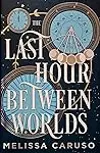
2.75 stars rounded up
The Last Hour Between Worlds is about Kembral, a woman whose job it is to go into the echos of reality to save those who have become lost within them. She is currently on maternity leave, but while attending a New Year’s party, work seems to find her. I actually think this book will work for many people, just not me. The reason this book wasn’t for me is simple: I’m not a mom and I have zero desire to be one. Kembral’s whole identity is centered in the fact that she is a new mother. I have no doubt that new mothers probably feel very seen by this book, the struggles she’s facing around whether to return to work/which parts of work, and the bodily changes that come from having a baby. I totally respect that. However, I got so tired of hearing about her baby and how she wanted to be where she was and also wanted to be with her baby and how her baby rearranged her insides before being born. Again, I am sure this is super relatable for those who have experienced this, but I got so tired of it pretty quickly. My more neutral complaints: the world building was…odd. It felt like a lot of information was info dumped but at the same time nothing really made sense. A lot of the victories our protagonists had were honestly more luck than anything else. We get told over and over how wonderful she is at her job, but i never really saw it. A lot was left unexplained. Things happen and then we just keep moving forwarding. Lastly, some of the writing was very campy/cringey and I didn’t vibe with it. I think the idea behind this book was great, but the execution was just not it for me. I will say I did think the small hints of romance were nice and pretty well done.
Note: I didn’t remove stars for this, but while the audiobook narrator was good and I’ve liked her work before, the bongs she did for the clock drove me bonkers.
2.75 stars rounded up
The Last Hour Between Worlds is about Kembral, a woman whose job it is to go into the echos of reality to save those who have become lost within them. She is currently on maternity leave, but while attending a New Year’s party, work seems to find her. I actually think this book will work for many people, just not me. The reason this book wasn’t for me is simple: I’m not a mom and I have zero desire to be one. Kembral’s whole identity is centered in the fact that she is a new mother. I have no doubt that new mothers probably feel very seen by this book, the struggles she’s facing around whether to return to work/which parts of work, and the bodily changes that come from having a baby. I totally respect that. However, I got so tired of hearing about her baby and how she wanted to be where she was and also wanted to be with her baby and how her baby rearranged her insides before being born. Again, I am sure this is super relatable for those who have experienced this, but I got so tired of it pretty quickly. My more neutral complaints: the world building was…odd. It felt like a lot of information was info dumped but at the same time nothing really made sense. A lot of the victories our protagonists had were honestly more luck than anything else. We get told over and over how wonderful she is at her job, but i never really saw it. A lot was left unexplained. Things happen and then we just keep moving forwarding. Lastly, some of the writing was very campy/cringey and I didn’t vibe with it. I think the idea behind this book was great, but the execution was just not it for me. I will say I did think the small hints of romance were nice and pretty well done.
Note: I didn’t remove stars for this, but while the audiobook narrator was good and I’ve liked her work before, the bongs she did for the clock drove me bonkers.
Updated a reading goal:
Read 40k pages in 2026
Progress so far: 1834 / 40000 4%

The Eyes Are the Best Part is an odd horror/thriller that starts off as more of a family drama than anything else. Our protagonist is Ji-won. She is a college student who lives with her mother and younger sister in the after math of her father leaving the family. Throughout the story Ji-won faces societies views on Asian women, grapples with her cultural beliefs and experiences, as well as tries to navigate her ever changing life.
“I know [it] is pretty, but poison is everywhere, even in the places where you least expect it.”
Honestly, this book is a little bit of a roller coaster. I found Umma, her mother, to be incredibly frustrating to read from, and honestly? Aside from Ji-Won’s sister and Alexis, everyone sucked. And while I can’t condone anything Ji-Won did in this book, I also feel like…good for you, you know? I feel like I can’t say anything more without giving spoilers, but I do have spoiler section below. To sum up this section, however, the story was weird and interesting and gross (as it intends to be). If you’re looking for a slow, creeping horror that takes it time and isn’t steeped in the super natural, this might fit. . . . . . . . . . . . . . So I mostly left this book conflicted about my feeling because of Ji-won. On one hand I felt like I had to root for her. George was literally the worst. Like, girl, please get rid of him. Honestly, go after your dad too, because he also sucks. I can’t even really feel that for Geoffrey because he refused to take no for an answer and surely would have escalated things. As a girls girl, I automatically took these as truths, however, on further reflection, can we trust any of this? Her perception is clearly warped and she is far from a reliable narrator. She is constantly hallucinating (could be guilt driven, but I’m not so sure about that). She manipulates everyone around her. It is possible these people weren’t as awful as they seemed and her mother wasn’t as weak, but she amplified these people’s traits in her own mind. And then, of course, she DID kill that random (presumably) homeless guy and that random college kid, which, you know, not great. The book clearly wanted the reader to think she was like this because of the brain tumor (for at least a few moments) but then makes it clear that isn’t the cause. So that’s where my second issue comes in. Why? What triggered her to be like this? Eating a fish eye one time?? Like the murdering awful men I could almost get, but the cannibalism seemed to come out of nowhere.
I don’t know. I didn’t hate the book, but it was certainly strange.
The Eyes Are the Best Part is an odd horror/thriller that starts off as more of a family drama than anything else. Our protagonist is Ji-won. She is a college student who lives with her mother and younger sister in the after math of her father leaving the family. Throughout the story Ji-won faces societies views on Asian women, grapples with her cultural beliefs and experiences, as well as tries to navigate her ever changing life.
“I know [it] is pretty, but poison is everywhere, even in the places where you least expect it.”
Honestly, this book is a little bit of a roller coaster. I found Umma, her mother, to be incredibly frustrating to read from, and honestly? Aside from Ji-Won’s sister and Alexis, everyone sucked. And while I can’t condone anything Ji-Won did in this book, I also feel like…good for you, you know? I feel like I can’t say anything more without giving spoilers, but I do have spoiler section below. To sum up this section, however, the story was weird and interesting and gross (as it intends to be). If you’re looking for a slow, creeping horror that takes it time and isn’t steeped in the super natural, this might fit. . . . . . . . . . . . . . So I mostly left this book conflicted about my feeling because of Ji-won. On one hand I felt like I had to root for her. George was literally the worst. Like, girl, please get rid of him. Honestly, go after your dad too, because he also sucks. I can’t even really feel that for Geoffrey because he refused to take no for an answer and surely would have escalated things. As a girls girl, I automatically took these as truths, however, on further reflection, can we trust any of this? Her perception is clearly warped and she is far from a reliable narrator. She is constantly hallucinating (could be guilt driven, but I’m not so sure about that). She manipulates everyone around her. It is possible these people weren’t as awful as they seemed and her mother wasn’t as weak, but she amplified these people’s traits in her own mind. And then, of course, she DID kill that random (presumably) homeless guy and that random college kid, which, you know, not great. The book clearly wanted the reader to think she was like this because of the brain tumor (for at least a few moments) but then makes it clear that isn’t the cause. So that’s where my second issue comes in. Why? What triggered her to be like this? Eating a fish eye one time?? Like the murdering awful men I could almost get, but the cannibalism seemed to come out of nowhere.
I don’t know. I didn’t hate the book, but it was certainly strange.