
altlovesbooks

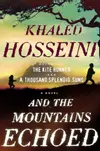
This just wasn’t as good as The Kite Runner or A Thousand Splendid Suns, I’ll just say that up front. I hate saying that because those books are very good books, but this one just felt disjointed and not altogether what I was hoping for from Hosseini.
Abdullah and Pari, brother and sister, grow up in a small village in Afghanistan—at least, until their father, lured in with money by his brother, sells Pari off to a well-off family in Kabul, breaking the two apart for the rest of their lives. Apart from the very beginning and the very end, the rest of this book concerns tangential people in Afghanistan and Paris, people who have contact with either Abdullah or Pari, or people related to them, and we hear their stories unfolding alongside these two siblings. A doctor, a neighbor, a friend of the family, several generations of stories are included here, all with their own related story that we hear instead of resolving what happens to Abdullah and Pari.
It’s an interesting format, but the feel of the whole book was like a compilation of short stories more than it is a cohesive whole. Some of these short stories are written well and compelling, but others (the one involving the son of the commander comes to mind) felt rushed and incomplete. These could be entire books in their own right if given the time and the pages, but instead are condensed down into 80 or so pages each. It just made the whole thing feel fragmented. I also wasn’t quite satisfied with the resolution to the "main" Abdullah/Pari story either, because we spend so much time on other characters, I never really got to know them enough to really feel invested in what happens.
I don’t know, this was kind of a miss for me. Still a decent book, but I feel like it isn’t the author’s best work by a long shot.
This just wasn’t as good as The Kite Runner or A Thousand Splendid Suns, I’ll just say that up front. I hate saying that because those books are very good books, but this one just felt disjointed and not altogether what I was hoping for from Hosseini.
Abdullah and Pari, brother and sister, grow up in a small village in Afghanistan—at least, until their father, lured in with money by his brother, sells Pari off to a well-off family in Kabul, breaking the two apart for the rest of their lives. Apart from the very beginning and the very end, the rest of this book concerns tangential people in Afghanistan and Paris, people who have contact with either Abdullah or Pari, or people related to them, and we hear their stories unfolding alongside these two siblings. A doctor, a neighbor, a friend of the family, several generations of stories are included here, all with their own related story that we hear instead of resolving what happens to Abdullah and Pari.
It’s an interesting format, but the feel of the whole book was like a compilation of short stories more than it is a cohesive whole. Some of these short stories are written well and compelling, but others (the one involving the son of the commander comes to mind) felt rushed and incomplete. These could be entire books in their own right if given the time and the pages, but instead are condensed down into 80 or so pages each. It just made the whole thing feel fragmented. I also wasn’t quite satisfied with the resolution to the "main" Abdullah/Pari story either, because we spend so much time on other characters, I never really got to know them enough to really feel invested in what happens.
I don’t know, this was kind of a miss for me. Still a decent book, but I feel like it isn’t the author’s best work by a long shot.

"At Least He Never Walked"
Where I’m an avid Haruki Murakami fan, me and running are casual acquaintances at best. I don’t enjoy running the way other runners seem to, and even trying to understand the mentality is foreign to me. I have incredible respect for people who are runners, let alone ultramarathon runners and triathlon competitors, it’s just not something for me. So when a gathering of friends decided to get together to read this book (as we all respect Murakami as a writer to varying degrees), I almost passed. I’m actually glad I didn’t, because there’s more to this book than a man talking about how much he loves running.
I mean, there’s tons of that too. Murakami is an accomplished runner as well as an author, and he has all the right to talk to us about how he prepares for marathons and approaches running in general. He lives an incredibly disciplined lifestyle, makes time for a considerable amount of running each day, and generally takes very good care of himself. There’s lots here for the people who run, where Murakami finds the motivation to do so, how deep he has to dig when he’s in the thick of a marathon, the mental preparations he goes through leading up to a race. I mean, at the core of it, it’s just a matter of strapping on some sneakers and going at it, but it’s easy to say that on paper and a thousand times harder to actually do.
For the rest of us like me, who find running a chore and something to only trot out when escaping a bear or something, there’s good thoughts here too. I liked Murakami’s thoughts on persistence, approaching tough problems, and many other little things that I can apply to everyday life. The troubleshooting he goes through to figure out a problem (like his swimming form) and the importance of just keeping at something are good things to keep in the back of your brain. While you may not be swimming, being able to identify a problem exists and trying to figure out how to fix it rather than just scrapping the whole thing/idea/race/hobby will get you far.
Not a long book, but I appreciated this look into his head as he runs.
"At Least He Never Walked"
Where I’m an avid Haruki Murakami fan, me and running are casual acquaintances at best. I don’t enjoy running the way other runners seem to, and even trying to understand the mentality is foreign to me. I have incredible respect for people who are runners, let alone ultramarathon runners and triathlon competitors, it’s just not something for me. So when a gathering of friends decided to get together to read this book (as we all respect Murakami as a writer to varying degrees), I almost passed. I’m actually glad I didn’t, because there’s more to this book than a man talking about how much he loves running.
I mean, there’s tons of that too. Murakami is an accomplished runner as well as an author, and he has all the right to talk to us about how he prepares for marathons and approaches running in general. He lives an incredibly disciplined lifestyle, makes time for a considerable amount of running each day, and generally takes very good care of himself. There’s lots here for the people who run, where Murakami finds the motivation to do so, how deep he has to dig when he’s in the thick of a marathon, the mental preparations he goes through leading up to a race. I mean, at the core of it, it’s just a matter of strapping on some sneakers and going at it, but it’s easy to say that on paper and a thousand times harder to actually do.
For the rest of us like me, who find running a chore and something to only trot out when escaping a bear or something, there’s good thoughts here too. I liked Murakami’s thoughts on persistence, approaching tough problems, and many other little things that I can apply to everyday life. The troubleshooting he goes through to figure out a problem (like his swimming form) and the importance of just keeping at something are good things to keep in the back of your brain. While you may not be swimming, being able to identify a problem exists and trying to figure out how to fix it rather than just scrapping the whole thing/idea/race/hobby will get you far.
Not a long book, but I appreciated this look into his head as he runs.


"It comforts her that for every path she’s taken during her many revolutions around the world—for every individual footstep, it seems—there’s a story."
Kind of a melancholic book overall, but also one that made me think about the value of living in the moment, about all the stories one makes in a lifetime, and how you can affect someone from just a brief meeting and never even know it. I finished this book yesterday but still find myself thinking about it at work, so I guess that’s the mark of something I really got a lot out of.
Aubry harbors a disease. Not a contagious disease, but one that, if left untended too long, will kill her. The treatment isn’t a conventional one—as long as she keeps traveling, the disease stays dormant. But stay in any one place for more than a couple days, and it rears its ugly, bloody, awful head and Aubry must move on or die. She can’t retrace her steps, can never return to cities she’s already been, and thus can’t form prolonged attachments to people or places without being forced to give them up to keep her disease happy. This is a story of her journey, the places she travels, the people she meets, and how this endless cycle that dominates her life affects her.
First and foremost, not a lot happens. I know that’s a weird thing to say given the premise, but the story is about Aubry’s journey and not about the disease per se. Lots of short stories in Aubry’s life, but don’t go into this expecting neat answers. It’s very much in the realm of magical realism, from some of the situations Aubry ends up in and some of the people she meets, but the book still maintains one foot in reality and always brings her back. I really enjoyed the journey and was able to overlook that some of my main questions were never explicitly answered in the process, but it might not hit the right notes for someone looking for a definitive resolution.
I really did love the way this author wrote Aubry. We follow her on her journey from the first days of her disease, to when she starts running from her disease, to when she starts hunting her disease, and finally to when she starts accepting her disease. All along the way I felt simultaneously bad for Aubry who has to give up all these people and places she loves every few days and also really admiring the mental fortitude it took her to do it. The longer she’s with this disease the more it starts wearing on her, and I appreciated that the author was able to convey that so well.
Just a beautiful, melancholy story about a woman and her time in the world. I really loved it, honestly.
"It comforts her that for every path she’s taken during her many revolutions around the world—for every individual footstep, it seems—there’s a story."
Kind of a melancholic book overall, but also one that made me think about the value of living in the moment, about all the stories one makes in a lifetime, and how you can affect someone from just a brief meeting and never even know it. I finished this book yesterday but still find myself thinking about it at work, so I guess that’s the mark of something I really got a lot out of.
Aubry harbors a disease. Not a contagious disease, but one that, if left untended too long, will kill her. The treatment isn’t a conventional one—as long as she keeps traveling, the disease stays dormant. But stay in any one place for more than a couple days, and it rears its ugly, bloody, awful head and Aubry must move on or die. She can’t retrace her steps, can never return to cities she’s already been, and thus can’t form prolonged attachments to people or places without being forced to give them up to keep her disease happy. This is a story of her journey, the places she travels, the people she meets, and how this endless cycle that dominates her life affects her.
First and foremost, not a lot happens. I know that’s a weird thing to say given the premise, but the story is about Aubry’s journey and not about the disease per se. Lots of short stories in Aubry’s life, but don’t go into this expecting neat answers. It’s very much in the realm of magical realism, from some of the situations Aubry ends up in and some of the people she meets, but the book still maintains one foot in reality and always brings her back. I really enjoyed the journey and was able to overlook that some of my main questions were never explicitly answered in the process, but it might not hit the right notes for someone looking for a definitive resolution.
I really did love the way this author wrote Aubry. We follow her on her journey from the first days of her disease, to when she starts running from her disease, to when she starts hunting her disease, and finally to when she starts accepting her disease. All along the way I felt simultaneously bad for Aubry who has to give up all these people and places she loves every few days and also really admiring the mental fortitude it took her to do it. The longer she’s with this disease the more it starts wearing on her, and I appreciated that the author was able to convey that so well.
Just a beautiful, melancholy story about a woman and her time in the world. I really loved it, honestly.

"Let me tell you a story. Once upon a time there was a place with no nightmare painters. Then the people got eaten. It’s a short story."
I thought Tress of the Emerald Sea was going to be my favorite of the secret projects, and was not prepared for the ride this book took me on. I’ll be up front in saying that I don’t obsess over the Cosmere, and in fact have read things all out of order from “The Proper” reading order. This book absolutely can stand on its own, no Cosmere background necessary, but there are small details (and probably more than I noticed since I don’t retain small things book to book all that well) if you know where to look.
This book connects two people, Yumi and Painter, from two very different backgrounds. One grows up under strict guidance, her day dictated moment to moment, with no place for frivolous thoughts or actions. Her place in the world is to be the yoki-hijo, the one chosen to speak with spirits and get their cooperation in helping the people of her world. The other also dedicates himself to his people, but his service takes the form of being a Nightmare Painter—one who banishes dark spirits that materialize in his city and feed on the bad dreams of its residents. The more dreams it eats, the stronger it gets. A plea from a spirit brings Yumi and Painter together, where they each experience the other’s life in their body and have to figure out the what and the why of things before it’s too late.
In true Sanderson fashion the “what” and the “why” do a lot of the heavy lifting in this story, and things are kept appropriately mysterious until near the end. I loved the continuing discussion about the value of art, the power of friendship (in a not overbearing way), and how two opposites can come together and make something special together. There’s also quite a bit of irreverent commentary (from our narrator telling the story, someone you’ve met before if you’ve read other Sanderson books), some very touching moments, and a romance that didn’t have me rolling my eyes. That, dear reader, is kind of a rare thing for me.
It (obviously) has strong Japanese roots in the story, which is acknowledged by Sanderson in the afterward (mild influence spoilers) (both Final Fantasy 10 and Hikaru no Go are sampled from here, but twisted enough to be satisfyingly different), so if that feel of story isn’t your thing, you might be disappointed. I, on the other hand, was engaged throughout the whole book (even Tress had small sections that felt a bit drawn out to me), to the point of waking up two hours before work so I could finish it.
Highly enjoyed this one. Super, mega, totally recommend it.
"Let me tell you a story. Once upon a time there was a place with no nightmare painters. Then the people got eaten. It’s a short story."
I thought Tress of the Emerald Sea was going to be my favorite of the secret projects, and was not prepared for the ride this book took me on. I’ll be up front in saying that I don’t obsess over the Cosmere, and in fact have read things all out of order from “The Proper” reading order. This book absolutely can stand on its own, no Cosmere background necessary, but there are small details (and probably more than I noticed since I don’t retain small things book to book all that well) if you know where to look.
This book connects two people, Yumi and Painter, from two very different backgrounds. One grows up under strict guidance, her day dictated moment to moment, with no place for frivolous thoughts or actions. Her place in the world is to be the yoki-hijo, the one chosen to speak with spirits and get their cooperation in helping the people of her world. The other also dedicates himself to his people, but his service takes the form of being a Nightmare Painter—one who banishes dark spirits that materialize in his city and feed on the bad dreams of its residents. The more dreams it eats, the stronger it gets. A plea from a spirit brings Yumi and Painter together, where they each experience the other’s life in their body and have to figure out the what and the why of things before it’s too late.
In true Sanderson fashion the “what” and the “why” do a lot of the heavy lifting in this story, and things are kept appropriately mysterious until near the end. I loved the continuing discussion about the value of art, the power of friendship (in a not overbearing way), and how two opposites can come together and make something special together. There’s also quite a bit of irreverent commentary (from our narrator telling the story, someone you’ve met before if you’ve read other Sanderson books), some very touching moments, and a romance that didn’t have me rolling my eyes. That, dear reader, is kind of a rare thing for me.
It (obviously) has strong Japanese roots in the story, which is acknowledged by Sanderson in the afterward (mild influence spoilers) (both Final Fantasy 10 and Hikaru no Go are sampled from here, but twisted enough to be satisfyingly different), so if that feel of story isn’t your thing, you might be disappointed. I, on the other hand, was engaged throughout the whole book (even Tress had small sections that felt a bit drawn out to me), to the point of waking up two hours before work so I could finish it.
Highly enjoyed this one. Super, mega, totally recommend it.
