
beaneater

"Name. He made a reaching, a flash of demand, and it returned to him carrying what might be called definiton. It came, though, as pure concept. "Name" is the single thing which is me and what I have done and been and learned.
It was all there, waiting for that single symbol, a name. All the wandering, the hunger, the loss, the thing which is worse than loss, called lack. There was a dim and subtle awareness that even here, with the Prodds, he was not a something, but a substitute for something.
All alone."
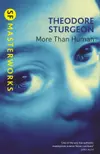
A complex novel about beings living on the margins of society who, outside human community, gradually form a new organism homo gestalt. Sturgeon doesn't focus on their exceptional abilities, but rather on their isolation, quiet suffering, and long existence beyond ordinary human relationships. The emergence of homo gestalt therefore feels not like a rescue, but like a consequence of evolution: an answer to a world in which there was no place for them.
Sturgeon’s prose is known for its lyrical and poetic style, already evident in the book’s opening section, The Fabulous Idiot. At the time of its publication, More Than Human presented a striking vision that was atypical even for the sci-fi of its era, and in many ways remains so today. In creating this novel, Sturgeon pointed toward a new direction in which science fiction could evolve.
"Name. He made a reaching, a flash of demand, and it returned to him carrying what might be called definiton. It came, though, as pure concept. "Name" is the single thing which is me and what I have done and been and learned.
It was all there, waiting for that single symbol, a name. All the wandering, the hunger, the loss, the thing which is worse than loss, called lack. There was a dim and subtle awareness that even here, with the Prodds, he was not a something, but a substitute for something.
All alone."
A complex novel about beings living on the margins of society who, outside human community, gradually form a new organism homo gestalt. Sturgeon doesn't focus on their exceptional abilities, but rather on their isolation, quiet suffering, and long existence beyond ordinary human relationships. The emergence of homo gestalt therefore feels not like a rescue, but like a consequence of evolution: an answer to a world in which there was no place for them.
Sturgeon’s prose is known for its lyrical and poetic style, already evident in the book’s opening section, The Fabulous Idiot. At the time of its publication, More Than Human presented a striking vision that was atypical even for the sci-fi of its era, and in many ways remains so today. In creating this novel, Sturgeon pointed toward a new direction in which science fiction could evolve.