
Laith

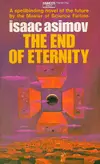
Like with most of the Asimov that I've read, the reading experience is colored by how deep and foundational his influence on the genre was; it felt like I'd read this before, like I knew what would happen from page one. It shouldn't be surprising given that Asimov is sort of the SF godfather, but End of Eternity is some of that good ol' classic Science Fiction, published in 1955 it's an early example of the time loop plot device/premise. I haven't read much of the Asimov catalogue outside the Foundation series and his notable short story collections, but he wrote like 500 books, so that's probably true for most people. End of Eternity is one of his better known novels, though a little buried behind the luster of Foundation and I, Robot. But it's clear to me that this stuck in the minds of its readers just as surely as those books did, because reading this book in 2025 is a lot like looking at a house partially built- the framing is all you can see.
The story follows Andrew Harlan, an Eternal. Harlan was taken from his time by an organization called Eternity, which exists across time and seeks to shepard mankind safely into the future. Harlan is trained as a technician in the service of Eternity, the individual designated to physically alter the past in order to change reality further down the timeline. Eternity is an insular and hermetic society, male dominated, so things predictably go awry when Harlan is asked to observe the 427th century in the company of *gasp* a woman. Enter Noÿs, the first and only woman Harlan has ever met and whom he immediately falls for in apocalyptic fashion, watch as Harlan burns it all down in the name of love.
The writing is pure Asimov, the intoxicating blend of speculative science and rock solid narrative fundamentals. I don't want to discount the book or downplay Asmiov's talents, but this is a casual, easy reading thriller whose complexity is entirely rooted in the time travel. Asimov never really reinvented the wheel when it came to story structure, he was happy to play with established tropes, instead choosing to focus on delivering hard science in an informal style. You won't ever get lost reading Asimov, but if you're like me, and you read a ton of SF that's not necessarily an entirely good thing. The over reliance on basic storytelling techniques means that a lot of this book can be boiled down to TV-trope tags, in fact we can run the list: Temptress and Forbidden Love, The Order is Not What it Seems, Woman as Catalyst, Reluctant Lover, and more than any other Disruption as Salvation are all tropes present in their most archetypical form.
With that said, I have no problem with an old story like this being a little mechanical if it prevents the text from feeling dated or stuffy down the line. That's the magic of Asimov, his simple and casual style is one that easily transcends the decades, it makes these stories just as interesting and captivating to read in 2025 as they were in 1955. Unfortunately, a story like End of Eternity is a victim of its own success; so much of what has come after this book has been inspired by and is emulating this framework that it reads like it's the one doing the copying. The Inverted World is the chief example that I can point to; so much of the structure of that book is directly lifted from Asimov, from the repetition of tropes and themes to even its principal character "Helward", which could be a subtle a nod to Harlan.
If you've read Asimov before, then you know exactly what to expect. If you haven't, what are you doing! Go read Foundation!
PS: This book in its original unpublished draft was standalone, but upon further consideration, Asimov changed the ending in order to tie this book into his larger Robots/Foundation universe. So I guess what I said at the top about only reading Foundation and his short stories is still technically true.
Like with most of the Asimov that I've read, the reading experience is colored by how deep and foundational his influence on the genre was; it felt like I'd read this before, like I knew what would happen from page one. It shouldn't be surprising given that Asimov is sort of the SF godfather, but End of Eternity is some of that good ol' classic Science Fiction, published in 1955 it's an early example of the time loop plot device/premise. I haven't read much of the Asimov catalogue outside the Foundation series and his notable short story collections, but he wrote like 500 books, so that's probably true for most people. End of Eternity is one of his better known novels, though a little buried behind the luster of Foundation and I, Robot. But it's clear to me that this stuck in the minds of its readers just as surely as those books did, because reading this book in 2025 is a lot like looking at a house partially built- the framing is all you can see.
The story follows Andrew Harlan, an Eternal. Harlan was taken from his time by an organization called Eternity, which exists across time and seeks to shepard mankind safely into the future. Harlan is trained as a technician in the service of Eternity, the individual designated to physically alter the past in order to change reality further down the timeline. Eternity is an insular and hermetic society, male dominated, so things predictably go awry when Harlan is asked to observe the 427th century in the company of *gasp* a woman. Enter Noÿs, the first and only woman Harlan has ever met and whom he immediately falls for in apocalyptic fashion, watch as Harlan burns it all down in the name of love.
The writing is pure Asimov, the intoxicating blend of speculative science and rock solid narrative fundamentals. I don't want to discount the book or downplay Asmiov's talents, but this is a casual, easy reading thriller whose complexity is entirely rooted in the time travel. Asimov never really reinvented the wheel when it came to story structure, he was happy to play with established tropes, instead choosing to focus on delivering hard science in an informal style. You won't ever get lost reading Asimov, but if you're like me, and you read a ton of SF that's not necessarily an entirely good thing. The over reliance on basic storytelling techniques means that a lot of this book can be boiled down to TV-trope tags, in fact we can run the list: Temptress and Forbidden Love, The Order is Not What it Seems, Woman as Catalyst, Reluctant Lover, and more than any other Disruption as Salvation are all tropes present in their most archetypical form.
With that said, I have no problem with an old story like this being a little mechanical if it prevents the text from feeling dated or stuffy down the line. That's the magic of Asimov, his simple and casual style is one that easily transcends the decades, it makes these stories just as interesting and captivating to read in 2025 as they were in 1955. Unfortunately, a story like End of Eternity is a victim of its own success; so much of what has come after this book has been inspired by and is emulating this framework that it reads like it's the one doing the copying. The Inverted World is the chief example that I can point to; so much of the structure of that book is directly lifted from Asimov, from the repetition of tropes and themes to even its principal character "Helward", which could be a subtle a nod to Harlan.
If you've read Asimov before, then you know exactly what to expect. If you haven't, what are you doing! Go read Foundation!
PS: This book in its original unpublished draft was standalone, but upon further consideration, Asimov changed the ending in order to tie this book into his larger Robots/Foundation universe. So I guess what I said at the top about only reading Foundation and his short stories is still technically true.