
Michelle Dsouza

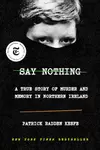
I came to the Troubles the way a lot of people my age did, sideways, through Derry Girls. I knew the broad shape of it. The Good Friday Agreement, the sense of a tragedy that had already been filed away as history. I picked up Say Nothing as a primer before reading Patrick Radden Keefe's newer book, expecting true crime. What I got instead was a history lesson I didn't know I needed and don't regret for a second.
The book opens with the 1972 abduction of Jean McConville, a widowed mother of ten taken from her home in the Divis Flats in front of her children and disappeared. Keefe uses her killing as the thread that pulls the whole sweater apart, moving through the lives of Dolours Price, the IRA volunteer turned hunger striker, and Brendan Hughes, and eventually toward the long shadow Gerry Adams casts over all of it. The scope is enormous. That's the book's strength and occasionally its weight. It took me seven days to read, not because it dragged, but because I kept stopping to sit with what I'd read, and more than once to research online and check what was actually confirmed versus what remains contested.
That instinct turned out to matter. The McConville killing unsettled me most. She was accused of being an informer, but the more I sat with it, the less the justification held. How would she have passed information? The Divis Flats were notorious for paper-thin walls. A household that surveilled would have left witnesses, corroboration, a trail. There isn't one. Keefe doesn't hand you a verdict, and that restraint is part of what makes the book honest. He lets the doubt sit where it belongs.
What the book deepened for me is a pattern I keep returning to in my reading, in both fiction and non-fiction. In every one of these conflicts, humanity is the first casualty. Innocent lives are spent for the greed of power and politics, and the people who pay are almost never the ones who decided the price. The number of people in this book who genuinely believed that death was the answer is staggering. We may never see a united Ireland. One can hope. But the cost recorded here is its own argument against the certainty that drove it.
If I have a reservation, it's that the writing itself is functional rather than beautiful. Keefe is a meticulous researcher and a clear communicator, but the prose doesn't reach for anything beyond delivering the story, and the story is so strong it almost doesn't need to. This isn't a book you read for the sentences. You read it for the staggering accumulation of detail and the moral weight underneath it.
A history I came to expecting true crime, and left thinking about power, memory, and how easily both get rewritten.
Originally posted at www.instagram.com.
I came to the Troubles the way a lot of people my age did, sideways, through Derry Girls. I knew the broad shape of it. The Good Friday Agreement, the sense of a tragedy that had already been filed away as history. I picked up Say Nothing as a primer before reading Patrick Radden Keefe's newer book, expecting true crime. What I got instead was a history lesson I didn't know I needed and don't regret for a second.
The book opens with the 1972 abduction of Jean McConville, a widowed mother of ten taken from her home in the Divis Flats in front of her children and disappeared. Keefe uses her killing as the thread that pulls the whole sweater apart, moving through the lives of Dolours Price, the IRA volunteer turned hunger striker, and Brendan Hughes, and eventually toward the long shadow Gerry Adams casts over all of it. The scope is enormous. That's the book's strength and occasionally its weight. It took me seven days to read, not because it dragged, but because I kept stopping to sit with what I'd read, and more than once to research online and check what was actually confirmed versus what remains contested.
That instinct turned out to matter. The McConville killing unsettled me most. She was accused of being an informer, but the more I sat with it, the less the justification held. How would she have passed information? The Divis Flats were notorious for paper-thin walls. A household that surveilled would have left witnesses, corroboration, a trail. There isn't one. Keefe doesn't hand you a verdict, and that restraint is part of what makes the book honest. He lets the doubt sit where it belongs.
What the book deepened for me is a pattern I keep returning to in my reading, in both fiction and non-fiction. In every one of these conflicts, humanity is the first casualty. Innocent lives are spent for the greed of power and politics, and the people who pay are almost never the ones who decided the price. The number of people in this book who genuinely believed that death was the answer is staggering. We may never see a united Ireland. One can hope. But the cost recorded here is its own argument against the certainty that drove it.
If I have a reservation, it's that the writing itself is functional rather than beautiful. Keefe is a meticulous researcher and a clear communicator, but the prose doesn't reach for anything beyond delivering the story, and the story is so strong it almost doesn't need to. This isn't a book you read for the sentences. You read it for the staggering accumulation of detail and the moral weight underneath it.
A history I came to expecting true crime, and left thinking about power, memory, and how easily both get rewritten.
Originally posted at www.instagram.com.