
Kyrie

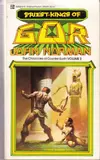
Priest-Kings at once amused and annoyed me.
When the story was actually moving, and Cabot wasn't stopping to describe each and every minute detail of Priest King culture, language, or religion, things could be entertaining. There were a moment or two of genuine laughs in there, hidden among the lectures on how many morphemes the Priest King's have in comparison to the morpheme count for English, German, and French.
I do not know whether there are more morphemes in the language of the Priest-Kings or in English, but both are apparently rich languages, and, of course, the strict morpheme count is not necessarily a reliable index of complexity of the lexicon, because of combinations of morphemes to form new words. German, for example, tends to rely somewhat more on morpheme combination than does English or French.
Don't get me wrong - the pacing of this installment of the Adventures of Tarl just dragged. So much of the story is bogged down in an infinite info-dump that when things actually do start happening, you're thankful for whatever brief change the book decides to throw at you.
I followed him, and the panel closed.
The floor seemed to drop beneath me and my hand grasped my sword.The Priest-King looked down at me and the antennae quivered as though in curiosity.
I resheathed my sword.
I was in an elevator.
While this book suffers from All Women Dream of Tarl Syndrome, at least there weren't any surprise appearances by the Ubar of the Tarns, which made the book feel much more original than Outlaw of Gor. The final stretch of the book had some really nice action scenes, as well. Hell, a good portion of the ending is nothing more than a glorified, continuous fight scene. It was a beautiful break from the monotony of listening to Cabot lecture about Priest King anatomy.
Things were going well. I was enjoying the story.
And then...Cabot spoiled everything.I've been going into these books with the mindset that what happens on Gor stays on Gor - it evolved in different ways from Earth, so I can't expect Gor to share the same values as its sister planet. It takes a bit of a stretch, but so far in the series, I had been able to detach myself and not really be bothered by the whole “all women should at some point be enslaved to a man” thing.
It certainly helped that Cabot looked at that cultural aspect of Gor from an outside perspective, and didn't blindly accept that the way women are treated on Gor was the right way of doing things.
The Gorean man...cheerfully and dutifully attends to the rescuing of his female in distress, but as a Gorean, a true Gorean, he feels, perhaps justifiably and being somewhat less or more romantic than ourselves, that he should have something more for his pains than her kiss of gratitude and so, in typical Gorean fashion, puts his chain on the wench, claiming both her and her body as his payment.
My eye was twitching at that point, but still I was willing to give Cabot the benefit of the doubt. As teeth-grindingly offensive as that was, Cabot was still looking at the issue as an Earth vs Gor comparison. But, he continued.
It seemed possible to me that one trait of high survival value might be the desire on the part of the woman to belong - utterly - to a man.
It seemed clear that woman would, if the race were to survive, have to be sheltered and defended and fed - and forced to reproduce her kind.
If she were too independent she would die in such a world and if she did not mate her race would die....I, like many Gorean masters, provided the girl was not testing or challenging me...preferred as a matter of fact to have my own name on the girl's lips, for I think, with acknowledged vanity, that there are few sounds as pleasurable as the sound of one's own name on the lips of a beautiful woman.
At that point, all of Cabot's objectivity died. He was no longer appraising the system as an outsider, but began including himself as a Gorean. I may have thrown my book against the wall at that point in the story.
Cabot's sudden need to monologue relentlessly about woman's place in the evolutionary chain of things just killed the book for me. I had actually been enjoying the story, info-dumps and all, up until that point. In the end, this was hard for me to settle on a rating for. I would have given the action sequences alone four stars, yet Cabot's evolutionary lecture was so rage inducing that that one scene should have dropped my rating down to two stars. So, I settled on three stars as a compromise.
Priest-Kings at once amused and annoyed me.
When the story was actually moving, and Cabot wasn't stopping to describe each and every minute detail of Priest King culture, language, or religion, things could be entertaining. There were a moment or two of genuine laughs in there, hidden among the lectures on how many morphemes the Priest King's have in comparison to the morpheme count for English, German, and French.
I do not know whether there are more morphemes in the language of the Priest-Kings or in English, but both are apparently rich languages, and, of course, the strict morpheme count is not necessarily a reliable index of complexity of the lexicon, because of combinations of morphemes to form new words. German, for example, tends to rely somewhat more on morpheme combination than does English or French.
Don't get me wrong - the pacing of this installment of the Adventures of Tarl just dragged. So much of the story is bogged down in an infinite info-dump that when things actually do start happening, you're thankful for whatever brief change the book decides to throw at you.
I followed him, and the panel closed.
The floor seemed to drop beneath me and my hand grasped my sword.The Priest-King looked down at me and the antennae quivered as though in curiosity.
I resheathed my sword.
I was in an elevator.
While this book suffers from All Women Dream of Tarl Syndrome, at least there weren't any surprise appearances by the Ubar of the Tarns, which made the book feel much more original than Outlaw of Gor. The final stretch of the book had some really nice action scenes, as well. Hell, a good portion of the ending is nothing more than a glorified, continuous fight scene. It was a beautiful break from the monotony of listening to Cabot lecture about Priest King anatomy.
Things were going well. I was enjoying the story.
And then...Cabot spoiled everything.I've been going into these books with the mindset that what happens on Gor stays on Gor - it evolved in different ways from Earth, so I can't expect Gor to share the same values as its sister planet. It takes a bit of a stretch, but so far in the series, I had been able to detach myself and not really be bothered by the whole “all women should at some point be enslaved to a man” thing.
It certainly helped that Cabot looked at that cultural aspect of Gor from an outside perspective, and didn't blindly accept that the way women are treated on Gor was the right way of doing things.
The Gorean man...cheerfully and dutifully attends to the rescuing of his female in distress, but as a Gorean, a true Gorean, he feels, perhaps justifiably and being somewhat less or more romantic than ourselves, that he should have something more for his pains than her kiss of gratitude and so, in typical Gorean fashion, puts his chain on the wench, claiming both her and her body as his payment.
My eye was twitching at that point, but still I was willing to give Cabot the benefit of the doubt. As teeth-grindingly offensive as that was, Cabot was still looking at the issue as an Earth vs Gor comparison. But, he continued.
It seemed possible to me that one trait of high survival value might be the desire on the part of the woman to belong - utterly - to a man.
It seemed clear that woman would, if the race were to survive, have to be sheltered and defended and fed - and forced to reproduce her kind.
If she were too independent she would die in such a world and if she did not mate her race would die....I, like many Gorean masters, provided the girl was not testing or challenging me...preferred as a matter of fact to have my own name on the girl's lips, for I think, with acknowledged vanity, that there are few sounds as pleasurable as the sound of one's own name on the lips of a beautiful woman.
At that point, all of Cabot's objectivity died. He was no longer appraising the system as an outsider, but began including himself as a Gorean. I may have thrown my book against the wall at that point in the story.
Cabot's sudden need to monologue relentlessly about woman's place in the evolutionary chain of things just killed the book for me. I had actually been enjoying the story, info-dumps and all, up until that point. In the end, this was hard for me to settle on a rating for. I would have given the action sequences alone four stars, yet Cabot's evolutionary lecture was so rage inducing that that one scene should have dropped my rating down to two stars. So, I settled on three stars as a compromise.