
Jessica


Two stars for being painful to read, not for being poor-quality (which it isn't).I'd previously read one other book by Doris Lessing, [b:The Good Terrorist 707060 The Good Terrorist Doris Lessing https://images.gr-assets.com/books/1358325562s/707060.jpg 2769827], and despite being written 35 years apart they share the same writing style. Both are unrelentingly bleak, with miserable and pathetic characters who nonetheless feel extremely believable in their hopelessness. You get the sense that Lessing might not have been the kind of person you'd want to befriend, with an eagerness to identify people's every personal failing and crucify them at length for it. She has a talent for it, of course, and in the case of The Grass is Singing the end result is a sharp criticism of the racist, nasty society of Southern Rhodesia. It's still not pleasant to read.The central characters of this book are Mary Turner and her husband, Dick. After a miserable rural childhood, Mary spent her young adult years “in town”, making good money in an office and filling her free time with parties, sports, social engagements, and so on. However, as she reached her mid-thirties she realised that her “friends” were all mocking her behind her back for her dress sense and lack of romantic entanglements, and so she cast about for a husband, any husband. She happened upon Dick, a poverty-stricken farmer, and after the most dire courtship of all time they married and she moved to his farm.There, Mary goes stir-crazy in a ramshackle house that offers little protection from the heat and too far away to enable much social interaction with other white people – just their neighbours, the Slatters, who Mary snubs at every opportunity because she's embarrassed by her poverty. Of course, she's also ashamed of her husband, who she sees as a failure, and vicious towards all their African workers, because she's convinced of their inferiority in relation to her and wants to make sure they know it.This book reminds me a lot of [b:Coonardoo 1961207 Coonardoo Katharine Susannah Prichard https://s.gr-assets.com/assets/nophoto/book/50x75-a91bf249278a81aabab721ef782c4a74.png 1964276], which was also written by a white, female socialist from a brutally racist settler-colonial society (in the case of Coonardoo, it takes place on a remote station in outback West Australia). In particular, both books share the same major flaw: despite the fact that they were written as rebukes of racism, the black characters are all so poorly and weakly depicted. They are not given clear motivations and complicated inner lives the way that all the white characters are; they're left as vague ciphers, ready to morph into plot devices whenever the author requires it. I know that these books were written decades ago, and were important works in their time. However, if you were to ask me whether these works are still relevant today, my answer would have to be probably not. There have to be so many better critiques of colonialism and racism, ones that don't fall into racist tropes themselves (and probably ones written by those who actually experience racism, although I do think it's important for the racially privileged to criticise it as well). Like, The Grass is Singing is bookended by a murder which never has its motive explained – apparently we're just supposed to assume Africans do things like that, sometimes, randomly, because they resent their oppression. It's the kind of ridiculous leap of logic that we'd never be expected to make for a white character.So overall, I dunno. While I can see why Lessing is so heralded as an author, I don't think her work is to my tastes and this book in particular made me uneasy. I also think it's weird that the blurb describes it as set in South Africa when it's not – was the publishing house really that ignorant, or did they assume their customers were? It's true that Ian Smith's illegitimate regime was very similar to South Africa's apartheid government, and critics of one tended to find themselves banned from the other as well (as happened to Lessing herself in 1956). They still weren't actually the same country, though. But regardless... significant as this book may be, it is flawed and not particularly enjoyable, so while you can read it if you want, I wouldn't suggest making it a high priority.


A worthy sequel to the first novel in this series, [b:Embers of War 30748899 Embers of War (Embers of War, #1) Gareth L. Powell https://images.gr-assets.com/books/1502367097s/30748899.jpg 51294683] (which I reviewed here). In that book, the spaceship Trouble Dog stumbled across a vast armada of sleeping warships and gave them a mission: to prevent further wars on the scale of the Apocalypse War that had just ended. Here, the ramifications of that suggestion are seen: that armada (now known as the Fleet of Knives) decides that the only sure way to do this is to destroy all warships (including the Trouble Dog which had awakened it) and eliminate interstellar travel.All the strengths of the first book remain strong here: the characterisation is excellent, with Nod the Druff (the Trouble Dog's engineer) getting some particularly awesome, wryly humorous POV chapters. Konstanz, Clay and Preston are back, picking up the pieces after the traumatic events of the first book. Ona Sudak returns, her past experience in the Apocalypse War making her uniquely qualified for service with the Fleet of Knives. And this time, we're introduced to the crew of Lucy's Ghost, “Lucky” Johnny Schultz & co., who attempt a salvage mission on a long-abandoned vessel originating from the alien Nymtoq civilisation... before an attack by interdimensional monsters, breaking through the fabric of reality, puts them into mortal strife.Once again, if you're the kind of person who craves stories about deep space but is sick of the macho, characterisation-light approach that plagues much of the genre, this series is a must-read. There are so many wonderful character moments between the action and plot developments, and everyone feels believable and richly complicated in their inner lives. I'm looking forward to seeing what happens in the next book.


If I could, I'd give this 3.5 stars.Lost Boy provides us with an origin story for Captain Hook, one exceedingly grim and full of carnage but also one with a lot of heart and soul behind it. In this book, Peter is a cavalier and self-obsessed boy, using his incredible charisma to convince young boys to join him in the Other Place so he can have them for playmates forever and ever... at least unless they die prematurely, in which case no matter, he can always go and get some more. Jamie, the protagonist, tries his best to protect the other boys and becomes increasingly disillusioned with Peter's reign of chaos.
It is a good book. I felt, personally, that the first part of it dragged on too long: not content with showing us one or two or three awful things Peter did to cause suffering among the boys, Henry shows Peter doing tons of such things. I felt like the first half (or more) of the book was a bit of a slog as a result: I didn't particularly enjoy reading about three-year-old Charlie crying and being threatened and feeling terrified and I was so impatient to get to the part of the book where things start coming unstuck for Peter. That part did come, and I was rewarded for my persistence, but it still felt a bit unsatisfying that a book of less than 300 pages could drag.
Pacing issues aside though, if you like dark retellings and you're suspicious of everything in Peter Pan, this is a good read.


While this is a work of science fiction, in tone it is much more like a work of epic fantasy. It tells the story of Genly Ai, an emissary from a broader human alliance on a remote, wintry planet where the people and the culture are utterly alien to them. A strong cultural value of shifgrethor (which is, roughly, about keeping face) seems, to him, to impede honest communication and leads him into political trouble in two countries. Then there is Estraven, prime minister of Karhide at the story's beginning but quickly disgraced and exiled, who must save him from the dire situation he gets himself into.Like most epic fantasy, the story unfolds at a glacial place. However, rapid-fire plot developments are not why anyone reads that genre. Where this book excels is the beautiful, intimate, and intricately detailed depiction of this world, which Ai's coalition simply refers to as Winter.The book is famous, of course, for the fact that the people of this world are ambisexual: androgynous for much of the month, but for a few days they go into kemmer (i.e. into heat) and will adopt a sexed form, the opposite one of their partner. Genly Ai, hailing from a society of “normal” humans, finds this very disorienting: he wants to pigeonhole everyone he meets into filling “male” or “female” gender roles (and mostly, the former) but then feels a private disgust when people he's mentally classed as male engage in “womanly” behaviours. That in itself is a fascinating theme of this story, and yet what I hadn't expected going in is that it's also only one part of a much larger work.Like in [b:The Dispossessed 13651 The Dispossessed (Hainish Cycle #6) Ursula K. Le Guin https://images.gr-assets.com/books/1353467455s/13651.jpg 2684122], social structures and the development of societies over time make up another big theme of this novel. Given the harshness of Winter's climate, Le Guin presents a world in which technological progress has unfolded at a very slow rate, although it does unfold – societies expend so many resources keeping themselves alive that they have little “surplus” for scientific progress. The first country that the reader is introduced to, Karhide, is an absolute monarchy where hospitality is an enormous, integral part of the traditional culture. From there the action moves to Orgoreyn, which is a more modern, communalist country which has much in common with the states of the former Eastern Bloc. Genly Ai is impressed by Orgoreyn at first, with their more generous provision of heating and governmental structure that isn't totally beholden to a single, paranoid king, and yet in the end it proves not to live up to his expectations.Aside from the world-building, the other main focus of this novel is the relationship between Genly Ai and Estraven, which builds slowly but is deeply compelling and heart-touching.In line with Goodreads' description of 4 stars as “I really liked it”, this is a book I'm giving four stars. It's a book that could easily deserve 5, but such dense, slow-paced books have trouble extracting 5 stars from me, so I'll leave it at four. Just know, though, that when I say I really liked it, I mean I really liked it.


I never got around to reviewing the first book in this series, [b:Vicious 40874032 Vicious (Villains, #1) V.E. Schwab https://images.gr-assets.com/books/1532011194s/40874032.jpg 19250870]. However, the two of them together would have to be my favourite of V.E. Schwab's series, hands down.While this book had a slow beginning, man did it ever pick up. It has a ton of compelling characters – a truly vast number of characters that a less talented author would have made a bewildering mess out of – who all have complicated backgrounds and motivations, and generally not ones beyond reproach. My favourite characters were some of the new ones – Marcella was extremely enjoyable to read about, and June was intriguing. Of course, many characters from the first book, like mortal enemies Victor and Eli, as well as Sydney Clarke, were major figures in this one as well.Overall, a great, fun book if you like reading about superpowers and grey-and-grey morality.


This book read a lot like an episode of Midsomer Murders (except with Americans in it). It's got shady cultists, pantomime villains, and the setting of a quaint old university town in England's south-east. It wasn't really my cup of tea, but if you like the sound of that then by all means give it a try.


This book was an easy read, but I can't say it was particularly impressive. It tells the story of Ellie, an all-American (and Jewish) schoolgirl who goes to Berlin on a school trip, touches the string of a red balloon, and finds herself instantly transported back in time to the eastern side of the city in 1988. She finds out that the red balloons are part of a long-term people smuggling operation: a clandestine magical organisation exists which creates these balloons to transport people out of dangerous places. With no obvious way to return home, she crashes in an organisational safe house with two other young people, immediately throws herself into a corny and unnecessary romance with one of them, and then gets caught up investigating a string of red-balloon-related murders.
While the bulk of the book takes place in 1988, there are also a number of chapters set 45 years earlier, where a Jewish boy relays his experience living through the Holocaust. These chapters were naturally pretty grim, but I also felt that they were by far the best part of the book. The Nazis' cruelty was viscerally clear, but we also saw people striving to resist: admiring the resistance put up by other ghettos, covertly practising their faith, communicating illegally with people outside the ghetto. This plotline could not fail to be tragic, but it was heartfelt and powerful.
Unfortunately I cannot say anything similar for the East Berlin chapters, at least not in regards to how they depicted their setting. In these, there is a lot of editorialising to keep reminding the reader that East Germany is a horrible, oppressive police state while the West is a beacon of freedom. It's an irritatingly trite take, and the book would have been better served by leaving those remarks out and just showing us what East Germany was like, you know, through the story. What did come across in the story felt like a more nuanced take, if still a bit surface-level in some respects – but perhaps that's to be expected when both POV characters in 1988 are outsiders to the country.
I thought Ellie, the protagonist, was pretty annoying. She has a really interesting plot thread to do with her Jewish faith and her family history (her grandfather, a Holocaust survivor, did not want her to go to Germany in the first place)... but it's also her POV chapters doing the bulk of the “Americans good, East Germans bad” thing. Kai and Mitzi, the other members of the trio, were much more likeable as far as I was concerned. All the other 1988 characters felt kind of generic, and the denouement lacked impact as a result. (I also thought it was unnecessary to have a whoooole thing stressing to the reader that Nazis are really, super evil, like you could have read the book up to that point and not got that.)
Despite this review being mostly negative, I did enjoy reading the book overall. The story moves along well, the prose is pleasant to read, there were a bunch of interesting passages, and I enjoyed the whole story thread about Ellie's heritage. I think I feel particularly frustrated because it was an idea with a lot of potential, but some fundamental mistakes (like the extraneous romance subplot and the simplistic depiction of East Berlin) really let it down.


Taste is subjective, and this book definitely won't please everyone (it spends a lot of time on love triangles and destiny), but I loved it. The story begins hundreds of years in the past, when a group of friends tried and failed to defeat an immortal, powerful spellcaster to prevent the forced marriage of one of their own. In the throes of defeat, they laid the seeds necessary to try the battle again at some point in the future. The majority of the book follows Gwendoline, the reincarnation of one of those friends, as she struggles with carrying out her destiny and also with a similar love triangle to the one that plagued her predecessor.
It's the kind of story that lives or dies on the strength of its characters, and evidently the good news here is that the characterisation is top-notch. The members of the core group are painfully true to life: pining after people they can't have, being indecisive, making bad impulsive decisions and regretting them, letting anger get in the way of working together to do what's necessary... their goals and motivations are often contradictory but so terribly relatable. Of particular note, I think, is the character arc of Everleigh, which was portrayed so well despite her perspective ending up so much at odds with Gwendoline's. Overall, the characters here were just utterly compelling.
On top of that, the prose was excellent: the battle scenes were tense and exciting, the kissing scenes and sex scenes (non-explicit though they are) were alluring, and for the most part the story unfolded at a great pace (although I might have preferred slightly fewer pages being given over to the love triangle subplot). I've spent a long time wishing that New Adult fiction was more of a thing, and now I've found this excellent example of it, I'm wishing even harder that it was more of a thing! This was an extremely enjoyable story.


In terms of its scientific accuracy, We Are Mars is hard sci-fi. Evidently, the story revolves around a colony on Mars. The surface of the planet remains inhospitable to life, albeit staggeringly beautiful to those who appreciate it. Life inside the compound sustaining the colony is tough, as the people there face the challenges of limited resources, crumbling machinery, and a Planet Earth that has lost interest in their project, and as such has mostly eliminated its support.
Not only does the plot look at the difficulties of trying to sustain human life in a hostile environment, but it also explores the dangers of trying to create genetically-perfect humans, a pandemic raging in a small, confined community, and some of the psychological effects of having to live in such a controlled, disciplined environment – where even such things as relationships are banned, because relationships can lead to babies, and babies drain resources that the project would prefer to reserve for the “perfect”, test-tube created, g-mods.
It manages to do all this while telling an extremely compelling thriller of a story (at least until the last part where things slow down somewhat), which is to be lauded. This is a really enjoyable hard sci-fi thriller with relevance to a lot of the topics being raised in the popular science sphere right now.
For me it wasn't quite a five-star book though. Mostly, I felt that it could have done with a bit more polish. There were a number of times that we, the reader, would be told how wise or caring or cool-under-pressure a certain character would be, when it would have been more satisfying to let those characters' actions stand for themselves. There was one specific character who ended up being quite different from what we were initially told her character was like, in a transition that didn't quite feel natural to me. The pace also slowed down considerably in the last part of the book, such that a big confrontation that you might have expected to be the climax of this book ends up being pushed off to the second in the series. Don't get me wrong – despite these doubts, I fully intend to read the second in the series – but that was a bit disappointing.
Overall, even though it lacks a little refinement, the raw excellence of the thriller pacing (throughout most of the book) and the well-researched, superbly-detailed science fiction storyline truly shine. Recommended for fans of the genre.


I'd highly recommend this to all fans of Douglas Adams. It does veer into darker, gruesome territory at times, but maintains a fairly light, humorous tone anyway. That said, this is definitely a book you need to pay close attention to. Don't make the mistake that I did and try to read it when you're very tired, distracted, or on a bus packed with boisterous private school kids, because you will get confused and have to re-read large chunks. This is a book to give undivided attention to.


On one level, this was a really interesting book. Over the week and a half that I was reading it, I spent so much time doing outside reading on the many topics it raised – the Great Fire of Smyrna (and how Greeks were pushed out of modern-day Turkey in general), the rise and fall of Detroit, race riots, “white flight”, and intersex conditions (like 5-alpha reductase deficiency, which Cal, the narrator, has). Although the book was better read in small doses, it was extremely absorbing and even once I'd walked away the themes would keep playing on my mind.
On another level, though, I'm not really satisfied with how the story was told. For a start, first-person omniscient is a weird perspective choice. Cal had an engaging voice, but there were so many times that it just got distracting that he knew so much about, say, what his grandparents thought about when they had sex. As well, the book felt somewhat disconnected. One of the other reviews described this book as being like two books glommed together – like Eugenides had written a compelling 150-page novella about Cal but then his publisher asked him to bolt a 400-page story about the Greek-American immigrant experience onto the start. This might not be what actually happened, but from reading it, you'd be forgiven for thinking it is. Both stories are interesting in their own right, but they don't really gel.
The other issue was that I felt like the story about Cal being intersex came out half-baked. The biological side was covered, and I really enjoyed the story of the younger Callie (as she was at the time) discovering the depth of her attraction to other girls and her friendship with the Obscure Object. The thing was that Cal's entire story up to and including this point seemed to be the story of a gay girl – he even states at one point that he never felt out of place as a girl, and even 25 years later still didn't feel entirely at home among men – and the decision to transition just seemed so rushed. I naturally understand why he wouldn't want “feminising” surgery, particularly given it carried the risk of him never experiencing sexual pleasure again, but his sense that he had to socially transition seemed to stem more from not wanting to be gay. Like, Cal had felt that it was wrong to be attracted to other girls, but if he'd secretly been a dude the whole time then phew! Actually it was OK to be attracted to girls all along – and in fact it proved his masculinity!
To be clear, I don't think Eugenides was trying to say that a defining feature of manhood or womanhood is attraction to the opposite sex. Really, I got the impression that he thinks gender itself is artificial, a social convention that we feel obliged to push onto people. Cal comments, towards the end of the book, that the leap from childhood to adulthood was far greater than that from girlhood to boyhood. Indeed, when he decides to transition, the changes that he makes are superficial things: a masculine wardrobe, a haircut, and learning to imitate men's body language. Cal is still fundamentally the same person he always was. I think it's also an important point that Cal's body – an intersex body – might have been atypical, but it wasn't unhealthy and didn't need artificial interventions like surgery. In the book, Cal never seems to feel ill-at-ease in his own skin: all his problems stem from other people's expectations. When he transitions, he does so because he feels his natural self runs closer to what society expects men to be than what it expects from women (including being attracted to women). However, whether as a girl or a man, the only discomfort he really feels is when he can't meet other's expectations: that is, he never gets his period or develops breasts as an adolescent, and he can't offer his lovers penile penetration as an adult, but these only pose problems in relation to others. Really, for him, gender is how society perceives him: he's the same Cal either way.
Even though it would have made the novel longer than it already is (which is almost 200,000 words – the longest book I've read so far this year), I think it could have done with more material (i.e. any material) on Cal growing up and going through young adulthood. The story ends when he's still only 15, a few months after finding out he's intersex, and aside from a few brief and woefully underdeveloped flash-forwards to 41-year-old Cal, we never really get to read anything about Cal getting to grips with manhood, the way we saw Callie grapple with what it meant to be a teenage girl. To me, this felt like a gaping hole in the story. Eugenides could even have slimmed down the 400-page “migrant experience” story to make more room for this (it was pretty verbose, after all). I think the book is lesser for not having it.
To try and wrap this all up, Middlesex is a ground-breaking, thought-provoking book, but it's also a bit of a mess and I feel like it will be (or will have been already) superseded by better books on intersexuality, the history of Detroit, and immigration (not necessarily all in the same book). It's worth reading, but I now feel like I'm on the look out for better treatments of these same themes.


This is a slow-paced, yet beautifully atmospheric and mysterious book. I've tagged it as fantasy, but it's more magical realism, set on the banks of the River Thames in 1887. There is a large cast of characters and while it was confusing to wrap my head around them all at first (taking notes helped), I was soon enough won over by their portrayals. The story is highly character-driven, which I always enjoy. No book can be to everyone's taste, but if this sounds like it might be up your alley, I highly recommend it.


I'm often a bit hesitant to start reading a space opera. There are lots of ideas and concepts the genre can explore that I find fascinating, and yet a lot of the genre seems to revolve around cardboard cut-out characters and “whose gun is bigger?” petty one-upmanship. Thankfully, that's not at all the case here!
Embers of War is set in a universe some years after an large-scale war that ended in a continent-spanning massacre on the planet of Pelapatarn. The impact left by this war continues to be strongly felt. There are a number of POV characters, including the sentient spaceship Trouble Dog, which had been the one ordered to fire missiles in the massacre of Pelapatarn, and seeks to redeem herself through service with the House of Reclamation – an altruistic organisation that sails through space on a shoestring budget, saving those in danger.
The plot revolves around a rescue mission – a ship carrying hundreds of people has been shot down in a hotly contested solar system where the “planets” consist of gigantic sculptures. Aboard the Trouble Dog, Sal Konstanz and her 2IC Alva Clay are sent to search for survivors. Joining them is a “medic” who turns out to be an unqualified 19-year-old whose father pulled strings to get him a gig. At a stopover point, they pick up two further passengers – Ashton Childe and Laura Petrushka – whose motivations are unclear and loyalty is questionable. Ashton, in turn, is on a mission to recover one specific passenger: Ona Sudak, a poet, although what makes her so important is something he doesn't know.
What impressed me throughout this book was the sheer depth of the characters. These are people (and a spaceship) who carry the emotional baggage of past tragedies around with them. You get to see their soft, vulnerable sides as well as their hard-as-nails businesslike sides.
I also appreciated the bit of philosophy that came through in the book – from the dilemma of whether or not it's right to commit a massacre to end a war, to questions of redemption and how possible that is to achieve, to Nod's conception of the circle of life. I'm not saying that any of these things were explored in great detail, but the inclusion at them at all added a nice humanistic touch (if you can say that about a book where there are many sentient beings other than humans).
Overall, this was a really enjoyable book. There is a sequel already out, which I've duly added to my ever-expanding TBR list.


My sister bought this book years ago for a university literature class and since then I've been begging her to let me borrow it. Finally, she came through with the goods – and what an amazing read it's been!
Marjane Satrapi moves elegantly through topics like the Iranian Revolution, Islamic fundamentalism, the Iran-Iraq war, “exile” and return. She's able to convey so much with so little: the weight of Iran's history and traditions, the brutal regime they lived under and feared before the revolution, and the brutal yet different regime that replaced it; the tragedy of war; the alienation of living in “exile” and the alienation of returning afterwards.
I also adored Marjane herself, as depicted in this memoir: precocious and sassy as a child, unable to restrain her outspoken tendencies as a teenager, and a rebellious young adult who keeps pushing the boundaries of respectable behaviour. She is a flawed character – selfish at times, and especially as the book went on a bit judgemental and withdrawn – but I found this refreshing. I feel like a lot of the time, male characters are “allowed” to be like this, and I appreciated seeing a female version for once.
In English these were originally published in two volumes, and of those I'd say that I preferred the first slightly over the second. The second volume did remind me somewhat of the 2011 film Circumstance, as another depiction of youth culture and rebellion in post-revolutionary Iran. Regardless, Persepolis as a whole is well-deserving of its stellar reputation.


This is one trip of a novel. There are a lot of interesting ideas and it was enjoyable to read, but at the end I feel vaguely confused, like when you wake up from a satisfying rollercoaster of a dream and then realise that actually none of it made any sense.
I guess it'd be too harsh to say that none of this book makes any sense. It's told in the first-person, present tense by Ces, a new arrival to a closed environment of a science experiment called Sound. In this place, food starts to lose all flavour and people lose their desire to eat, because the only thing that truly satisfies is loud, live music.
The world outside Sound seems to have gone to hell in a handbasket, with references to massacres, food shortages and other great disasters. The world inside Sound isn't very nice either, but you get the impression that people volunteer to be here because it's the greatest chance at security they have.
The story follows Ces as things in Sound go from bad to worse. I think I made a mistake trying to read this book on public transport – distracted is not what you want to be when you try to read this. There are too many characters to keep track of and, as mentioned, the plot is rather dreamily confusing. It's definitely interesting, though, and there is a satisfying conclusion.


A truly brilliant book. With a wide ensemble cast this is a novel with a lot going on, but it's interwoven well and told at a brisk, yet not rushed, pace.
As the title suggests, this is a story about time travel. There are a ton of interesting details about how that works in this universe: for example, there are no paradoxes, you can't go back and change time, every action that future time travellers have taken in the past is already accounted for. You also can't travel to before the existence of time machines, or to after their presumed destruction in the twenty-fifth century. Time machines in this universe are all under the control of a bureaucratic organisation called the Conclave, with a callous and somewhat sick culture. As you might also expect from the title, the effect that time-travelling has on an individual's psychology is also a big focus of the book.
But it's not just a book with some fascinating premises at play – it's also a book with strongly-developed, compelling characters and an intriguing plot. The main plotline concerns a murder – a twist on the “someone is shot dead, clearly not by themselves, in a room locked from the inside” trope. The victim of the murder isn't even known until over halfway through the book. There are a number of other interesting subplots too, dealing with work, family and love (the latter particularly in regards to a lesbian main character).
The only criticism I can really make is that it wasn't exactly a page-turner; with so many bite-sized chapters I felt pretty comfortable putting this book down at any old time before diving in sometime later. As such this is perhaps more of a commuters' book than one you'd sit down to read in one sitting. In case it's not clear, this is a very weak criticism; lots of meritorious books lack that compulsive, “I must binge this whole thing now” quality and sometimes it's nice to have one you can savour (and commute with without anguish). Highly recommended!
This book reads a lot like someone wrote up whatever happened in their RPG game – especially for the first 40% or so where the main trio are journeying ever-deeper into a dungeon, fighting rats and enchanted skeletons and stuff.
I guess the core plot is OK, but the book is extremely slow and the characters all feel pretty generic. There's a lot of emotional whiplash too... like there's a scene where they have to fight umpteen mooks at once, and they're all having a great time knocking them out but then they accidentally kill one and this is The Worst Thing Ever. Then very late in the book, they're all crying and upset about something Very Bad that's about to happen, but the evil person doesn't know their names so this immediately cheers them all up and they have a good giggle, even though the Very Bad Thing is still just about to happen. So, eh. I think this could've been saved with some rewriting, but clearly it wasn't.


Black Mamba Boy follows a boy named Jama as he struggles through crushing poverty and war in a number of locations: Yemen, Somalia, Eritrea, Egypt, Palestine and England. It's almost more of a travelogue than a novel; we follow Jama as he goes to different places and sees and does different things, but there's no real rising tension or climactic conclusion. Still, depending on your tastes that may well be no deterrent to you.


Blackout is a really enjoyable YA dystopian novel, set in a near-future UK where the government has been replaced by the dictatorial Board. The Board has successfully used “us and them” politics to demonise supposed drains on the economy – including, apparently, the entire country north of Birmingham. A massive wall has been erected to keep those parasitic Northerners out of the South, although most of the North's population has died anyway, after the Board shut off all supply lines. Life in the South is no picnic either, marked by harsh poverty, authoritarianism, and a fearsome criminal underworld. The gloomy, oppressive atmosphere is well-depicted over the course of the book.
This is a heavily character-driven novel, which is always my preference. Some of the characters are stronger than others (crime boss Daniel Redruth, in particular, seemed particularly one-note), but the relationships between them, usually characterised by tensions about how trustworthy anyone really is, are quite good. This is also a dialogue-heavy novel (which is fine by me), and there are regular flashbacks to show the characters' formative experiences and how the genocide of the North came about. Some of the other reviews have complained about the flashbacks being confusing, but I didn't feel that way.
The main thing that I was a bit doubtful about was the romantic subplot. The problem may have been that there was so much else going on in the novel that it didn't feel like the relationship had enough time to develop properly; most of those scenes felt a bit disjointed to me.
Overall, I'd thoroughly recommend this book. It's not perfect but it is very good, with timely commentary on the increasingly common “us and them”-style rhetoric.
Let's start with what's good about this book: the intricately detailed world-building, and the vivid descriptions that bring this world to life. At times, you can almost feel the hot desert winds bringing sand into the cities, or the gloomy cool of the underground water channels, one of which the characters use to travel between worlds. We're introduced to a complicated fantasy society, with a great number of cities within its boundaries, and pre-existing tensions and suspicions that add a lot of interest to Elabel's chapters. All of this, I really enjoyed.
On the other hand, the pacing of the book is very slow, the story is a bit confusing (or maybe it's more that most plot threads never got resolved – I guess the author intends to address them in future instalments of this series), and Elabel was the only character who really grabbed me. Realistically I wish I could rate this 2.5, but I don't think the setting alone warrants 3 stars. So this is a bit of a guilty 2 from me.


This book never really clicked for me. There were a lot of characters (maybe 30 or 40), who mostly all blend into one another, and not all of them get good explanations as to who they are or what their role is in the story. Perhaps because of this, I found the plot very hard to follow. There were a lot of subplots, and those that involved similar people doing similar kinds of things with motives/goals that were not fully clear were hard to disentangle. I know that the main plot involved some kind of betrayal against the company... and our chain-smoking, prostitute-obsessed macho man of a protagonist has to investigate this and exterminate the traitor... but then the company decides to exterminate him instead. Then there was also some poison rain or something, a slave girl with magic powers, and an old nuclear power plant with mutant people hanging out there, ready to attack people like in some cheesy FPS video game. I feel like you would need a notebook by your side to try to understand this book properly, and even then I get the sense the author is purposely leaving lots of stuff unexplained so people will buy the later books in the series. So, hmmm. While apparently this series has its fans, I'm not planning to continue with it.
As an aside, I also thought it was mildly hilarious that in Parry's vision of 2150, everyone is chain-smoking again like it's still 1950. Long-term social trends? Naw, what's that.


This Census-Taker did not start well. The beginning is slow, confusing, and nauseatingly gruesome. There came a point, though – once the narrative had actually caught up to the scene which opened the novel – where the haunting, gloomy atmosphere took over and I came to welcome the confusion.
The novella raises many questions, hardly any of which are answered by the conclusion. It's set in a small, macabre town, impoverished and largely isolated from the outside world. The narrator's father makes a habit of bashing animals to death and throwing them down a hole, for reasons which are never exactly explained to the reader, but can be guessed. He seems to progress to killing people; he seems to progress to killing the narrator's mother. The town has no real policemen, and the volunteers who stand in for them are friends with the narrator's dad and tell the boy that he must have imagined the whole thing. The story continues on.
In summary, this is a dark, atmospheric tale that you should only read if you can handle your questions going unanswered. That said, it's not too bad.


I really wanted to like this book. Indeed, there are some things I did like about it: the main characters are good, and the interplay between them is interesting. In many ways the bonus story was actually better than the novel itself (even though the novel had spoiled all the important parts), because it just examined the relationship between Lot and Bran, and was way more focused.
The main problem with this book is that it doesn't really flow. It's obvious that this was originally a web serial that's been compiled into an ebook. Events don't really seem to be caused by one another; instead, they just occur. And a lot of different, unrelated events occur, making it at times a bit confusing. I felt it could have done with way more text bridging between the chapters and explaining what was going on, how things were connected. The finale (Charlotte deciding to lure Richard over so he would turn her into a vampire, at which point she with her immunity to vampire powers could instead kill him) wasn't really built up to over the course of the book, and the only thing I noticed come up that really could have been an overarching plot (which was Lot beating up a lot of bad guys, and being asked by her priest/brother to go take down a specific bad guy who was hurting children... or something) ended up petering out into nothing, so far as I could tell.
I feel like if I had discovered the web serial version of this, and followed that instead of reading this book, I'd have liked it all a lot better. As I said the main characters are good, and the author has a refreshingly positive take on sexuality (especially considering the novel's setting in nineteenth-century London), although I did grow weary of how many minor characters felt the need to hurl sexist slurs at Lot (like, I just felt I'd got the point by the time it had happened three times already). I don't know, am I being too harsh? I just feel like a series of short stories with these characters, each with identifiable problems and climaxes, would have been more enjoyable. So, I'm rating this 2 stars for “OK” – potential was there, but it wasn't realised.
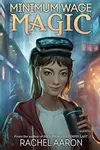


What a quick, fun read this was. Minimum Wage Magic (awesome title, incidentally) is a futuristic fantasy book set in the Detroit Free Zone, which I gather is the setting of a number of the author's other books. As a setting, it's nothing short of brilliant: a lawless high-tech urban society with interventionist gods, a city whose geography is constantly being shuffled about, and an extreme level of density that would've put the Kowloon Walled City to shame. It's a setting that screams to have TV series set there – a show with the vibe of Joss Whedon's Angel would work very nicely.The story itself was a bit weaker, but still highly enjoyable. It follows Opal Yong-ae, a graduate of a prestigious university who instead works as a Cleaner – that is, she buys the rights to clean out the apartments of people who've been evicted for non-payment of rent, in return for being able to resell their belongings at a profit. It's not exactly a common career path for someone with her levels of education, but Opal has her reasons: a massive debt to pay, and a strong inclination to live in hiding from the one she's repaying it to.At the outset of the book, Opal has been suffering through a five-month dry spell of not being able to make enough money back from the apartments she Cleans to cover her costs. So, when she gets one containing a dead man and a lot of interesting, mysterious magic, she senses profit to be made. She bids hard on a related apartment, and in so doing attracts a lot of attention: firstly from the bad guys, who are interested in the product of the magical ritual she's trying to piece together, and then from Nik, a fellow Cleaner who also likes profit and can sense that Opal is in over her head.And it is Nik, if anything, who makes up the one thing I didn't find satisfying about this book. From the moment he offers to help Opal, he's really the one who does everything. He knows where to go, who to see, and what needs to be done, while she just kind of tags along. At the end of the book, he's even the one who has to cover Opal's loan repayment, because she hasn't actually figured out a way of doing that despite it being her overriding goal throughout the whole book. The good news is that this is the first instalment of a series, and it is possible (though we shall see) that Opal's character development – becoming a capable person who can largely manage her own affairs – will be a major theme of it.Overall, this is probably a three-star book that gets kicked up a star due to its ridiculously awesome setting. I guess it's worth noting that while this is the first book of this series, there is another set in the same place, namely the Heartstrikers series that starts with [b:Nice Dragons Finish Last 20426102 Nice Dragons Finish Last (Heartstrikers, #1) Rachel Aaron https://images.gr-assets.com/books/1389049309s/20426102.jpg 30107715]. I don't know that dragons were really the most gripping part of this setting for me, but for more time in the DFZ it might be worth a try.