
Jessica


I feel bad leaving such a harsh review on a book that presently only has one other review, because that sways the average rating a lot and other people might not hate this book as much as I did and I'm kind of fucking things up for the author here. And yet, try as I might I cannot find any reason to give this book a second star. This is probably my most hated book since I read Dune.
The main reason I hated this book is the completely garbage morality tale the author felt obliged to impose on every single female character. Literally every woman in the entire book, with maybe one exception, eventually realises that the only true path to happiness is to quit her job, have a bazillion babies, and devote every second of her waking life to doing domestic chores for her husband. The only exception is a minor character who retires after a long career with Child Protection Services, and I'm mostly just assuming that she was happy with her life.
This novel leans really hard on the madonna/whore dichotomy. For all those female characters who haven't yet realised that the meaning of life is being a domestic slave for their husband, they fill their time with all kinds of sexual improprieties. I don't actually believe there's anything wrong with eschewing relationships and just having loads of casual encounters if everyone's on board with that and doing it safely... but this author sure seems to. This author also believes that “sleeping your way to the top” is an actual thing, and has two separate female characters do this (and what a coincidence, these are also the only two female characters with jobs that pay well). What's more, the male characters in this novel get even lousier characterisation: all of them are either embodiments of evil (like Emma's pedo-murderer uncle), or paragons of perfection (the Christian preacher dudes and that boyfriend Emma cheated on because ~she's a whore lol~).
There's a lot of other stuff that annoyed me in this book, too. Emma becomes obsessed with reading her uncle's boxes and boxes of diaries, because she wants to find the “answer” as to why he killed her mother and molested her. She finds the answer on day 1 (it's not like it's really deep or complex), but keeps reading for years and years on end anyway. She has a ton of “symbolic” dreams which are not really symbolic so much as they are extremely bleeding obvious. The ending to this book is extremely bleeding obvious (and I am that person who never figures out who the murderer was in a whodunnit until the denouement). The maid characters aren't very good – one of them randomly resents and snaps at Emma for reasons that are never explained, while the other is given terrible dialogue that doesn't match her linguistic background at all (she doesn't use any indefinite articles, even though Spanish – her native language – has these and uses them almost exactly like English does).
What positive things can I say about this book? Well... the depiction of the setting, Maine, was quite thorough and good. The pace of the novel was quite brisk overall, as well (although there were some pacing issues – events told when they should've been shown, while everything to do with the uncle's diaries just dragged and dragged). There was some realism in having the main character's friends drift in and out of her life, rather than having an ironclad group that remains equally as close forever.
Overall though, I could not recommend this book. Perhaps if the author had been a bit more upfront about the overtly Christian conservative messaging, I could've avoided it in the first place. It is categorised that way on Amazon, despite none of the blurbs or promotional tweets or the author's own website mentioning this (which is why I didn't notice until it was already too late). Unless you're the kind of Christian who thinks all women should be housewives, I recommend avoiding this book.


This novel had me seriously questioning my recollection of the first two novels. I remember thinking that they were so good, and then this one was just... somewhat mediocre.
Perhaps it was a terrible mistake to let so much time pass between reading the second and third books? By the time I started this one, I'd entirely forgotten that the previous book had ended on a cliffhanger, and I spent the first few chapters trying to remember what was going on. The characters didn't seem as compelling as I remembered them being. Other reviews have said that with the exceptions of Rhy and Holland, not a lot of character development goes on here, and that is true. Then between about 10%–60% of the way through the book, the plot progresses so slowly and it takes seemingly forever for the characters to decide what to do about the major problem facing them. Once they finally get an idea, they take detour after detour on their way to pursuing that idea. There are random chapters from the POV of minor characters who aren't even in the same London where the bulk of the action is happening, but a parallel one where nothing much is happening. It all just dragged so much, and it was hard to motivate myself to keep reading.
Then, from about that 60% mark, things started picking up. I wouldn't say I loved the book from that point on, but at least I felt engaged. I'd give this book 2.5 stars if Goodreads let me, but it doesn't really deserve a mere 2, so I'll round up.
I mean, there are good things about this book. The prose is high-quality. The system of magic is still interesting, although (and this might be because it's been two and a half years since I read the last instalment) I was never fully clear on what the actual limits were on what the main characters could do. You have a bit of ordinary, non-magical conflict between rival kingdoms in the world of Red London, which seemed a bit more interesting than the magical conflict, and exposed more interesting world-building. As I said before, Rhy goes through some interesting character development (considering he was never exactly my favourite character in this series), while Holland is just consistently this book's best character, from beginning to end. Lots of depth to him, darkness but also softness.
Overall, though, I feel relieved to have finally made it to the end of this book, and glad to have finished the series.


This is a wonderful book. Written in the first person, it tells the story of Richard Garay – a half-English gay Argentine – in such warm, intimate detail that you end up sucked in right through to the end. It starts slowly, with so much seemingly irrelevant detail that the first half can get a bit tiring, but it picks up.
Fundamentally, this is a story about Richard's longing to be loved and accepted for who he is. His parents were unable to give this to him, and despite a series of casual encounters which he very much enjoyed, he couldn't get it through his love life either until he found Pablo. The passages detailing his love for Pablo, their sweet domesticity, the simple happiness of being in one another's company, are some of the most enjoyable in the book. However, set in the 1980s, the spectre of HIV/AIDS rears its head and interferes in their blissful relationship.
As well as being a universal story about love, and a “gay” story about HIV/AIDS, this is also a story about Argentina and the tumultuous changes it was going through in the 1980s. This never becomes the main focus of the story, despite Richard being in prime position to observe the changes going on. Early in the book he describes being disturbed from a sexual encounter by lights going off and on at a police station across the street, and all the cars with their bonnets open so the power can be piped into the building. He asks his lover for that evening why, and the answer, of course? Because someone is being tortured inside. Later he tells a group of Americans that he hasn't known anyone who was harmed by the dictatorship, only for a classmate to interject with quiet indignation, and say that he's not sure how he can say that, when a mutual classmate of theirs was abducted and thrown into the ocean.
For the latter part of the novel, Argentina is transitioning to democracy, and selling off all its institutions to wealthy businessmen in North America and Europe. It's known by everyone that this policy will lead to mass suffering in Argentina, but people shrug their shoulders and figure it's simply what must be done. The picture Tóibín paints of Buenos Aires is bleak and cold, that of a worn-down city which lacks the energy to make anything better of itself. It's sad, but vividly portrayed.
Overall, this is an excellent book which – despite its slow start – I would highly recommend.


If any lasting harm had been done to Kleinkat, I'd have rated this book one star, I swear to God.
So, I read this book to learn a little bit more about the history and cultural background of South Africa, which I'm travelling to in just a few days and where my partner's family is from. Philida is a reasonable book for that, but it wasn't really a particularly enjoyable story. There is a lot of senseless cruelty (against cats and humans) which might be accurate for the period, but is unpleasant to read about. Philida herself is a good character, but everyone else in the story is rather shallow and often inconsistent. Frans Brink was particularly contemptible. It's not like there was nothing interesting or good about the book, but there was a lot dragging it down. Two stars.


There is a lot to like about this book. It deals with the potential environmental catastrophe facing this planet, from over-pollution to the collapse of food production. It imagines what human societies might look like after the crisis, with some in dome cities, others taking their chances scavenging in the poisonous wilds, others yet trying to establish free colonies. It also examines another interesting question, that of what is consciousness – can you transfer it into a computer system? Can you make copies of consciousness – make duplicate people? The pace of the book is brisk, with just enough description to bring its various locations vividly to life – humid biospheres, creepy fields of eyes...
This novel's downfall, I felt, was in the characterisation. While the setting and background information were thoroughly established, the characters and the relationships between them were not so convincingly portrayed. There was an entire romance that developed over the course of one “then a few weeks passed” paragraph. David Sparks himself lacked a strong identity, which is of course the point of the book, but it made him a less-than-gripping protagonist. Most of the side characters seemed to lack depth, too. There are a lot of things Aicher did well, but strong characterisation was not one of them.
Overall, your enjoyment of this book is going to vary depending on what you want to get out of it. If you're looking for a philosophical futuristic mystery with an ominous warning about where our society's wanton environmental destruction is taking us, then jump right in – it's excellent at being that. If you were hoping for more of a character-driven tale through the future, then recalibrate your expectations. I enjoyed this book, but it wasn't all I'd hoped it would be.


I've read both of de Robertis' previous novels, [b:The Invisible Mountain 5981625 The Invisible Mountain Carolina De Robertis https://images.gr-assets.com/books/1320552093s/5981625.jpg 6155001] and [b:Perla 12303508 Perla Carolina De Robertis https://images.gr-assets.com/books/1333576681s/12303508.jpg 17280681]. I adored them both. These tales of dictatorships and strong, decisive women have stuck in my heart for years now. I was disappointed that I did not enjoy The Gods of Tango the same way. I think primarily, it was a case of my expectations being too high – this was still a good book, and dealt with a theme I find interesting (namely, women in history refusing to comply with the norms forced on them by virtue of their sex)... it just didn't meet the dizzying heights of the others.So. This novel tells the story of Dante, who starts out as Leda, a seventeen-year-old widow who's just travelled across the seas from small-town Italy to Buenos Aires to be with her cousin-husband, only to discover he'd been shot dead at a protest just before her arrival. This poses a problem, since for a single, working-class woman in 1910s Buenos Aires, there is no way to keep oneself afloat besides prostitution, a fate Leda naturally wishes to avoid.So she reinvents herself. She takes a violin she brought over from Italy and her husband's clothes, and becomes Dante. Through persistence and a highly fortunate prodigious talent for the violin, she joins a tango orquesta and earns a living as a professional musician. She quickly adjusts to the masculine world, one of boozing, smoking and whoring. She finds other women alluring, irresistible, but is distressed by her inability to truly be intimate with them, seeing as she can't ever risk her secret being exposed. At last, she meets another woman, one who found a different way of transgressing those feminine gender norms, and they share a happily ever after together.Put like that, I very much enjoyed this story. On the other hand, the plot moved very slowly (and the entire first half held nothing that you didn't already know from the blurb, which seemed like a poor choice on the publisher's part) and the characters were less than strongly portrayed. At times I felt like the author got too caught up in her beautiful melodic prose (and really, it is lovely) and forgot to ensure the plot was rock-solid. There were a couple of sections where she switched to the point of view of another character, not Leda/Dante, when that wasn't really necessary. There was a fairly prominent subplot that ultimately proved pointless (all we learned was that sometimes girls are raped by their fathers... was that necessary?). The ending seemed to move a bit too quickly, and be a bit too neat. I felt that Leda/Dante herself was a bit of a cipher, someone who adapted her entire being to her circumstances rather than having a strong core identity of her own... which was, perhaps, the point, but I found it somewhat unsatisfying.Overall, I'd call this a worthwhile read if the themes or setting particularly interest you, but the story itself seems a bit on the weak side. A solid three-star book.


Eu sou ainda uma aprendiz de português, e este é um conto muito bom para qualquer pessoa em minha posição. Diz a história de um porco pessimista, quem descobre o destino que espera os que se distanciam do mundo e decide que não quer viver assim. É como uma fábula, lidando com sonhos e escolhas, e me lembrou um pouco de A Christmas Carol nesse sentido.
Se você tambem é um aprendiz de português, eu posso recomendar Readlang para ajudar lê-lo; eu o usei e me ajudava com o vocabulário (que não é muito difícil, mas há palavras que eu não conhecia).


There's a certain dreamlike quality about this book that makes it best read in one setting. Thankfully it's also fairly short (as I was starting, my Kindle estimated it'd take me two hours to reach the end), so it's doable. I read the first third of this book a bit at a time, and I found it hard to get into. The characters of Alice and Hatcher seemed rather closed-off and hard to get to know, and there was a lot of graphic, disturbing sexual violence. Like, we are talking creepy serial killer levels of perversion. I didn't get the impression that the author was including all of this because she thought it was titillating or edgy (quite the opposite, really – she dwelt more on the aftermath than the acts, and conveyed the horror well) but more to emphasise that this is well and truly a Crapsack World as well as to provide context for Alice's own experiences. Nonetheless, I was very guarded reading this book for a long time.
Once I decided I had a couple of hours free and would use them to read this book through to the end, my enjoyment of it increased immensely. Over the course of the novel, Alice and Hatcher – who had begun as prisoners in an old-timey insane asylum, having forgotten most of their lives from before – are filled in about the events missing from their memories and given a sense of purpose. Alice transforms from a confused, helpless young woman to a dedicated force of nature. Hatcher doesn't really change that much, but as Alice warms to him – and learns about his tragic past – so too does the reader. The novel follows them as they defeat a string of foes, conveniently led from one lair to the next by a series of irresistible clues, before finally encountering the Jabberwocky – the terrible villain whose reawakening led to their flight from the insane asylum in the first place. One subplot, that concerning Hatcher's daughter, is conveniently left unresolved to as to leave material for a sequel.
This book will not be to everyone's tastes. If you do not want to read a book where nearly every scene concerns rape, the fear of rape, or the aftermath of rape, you definitely should not read this book. On the other hand, if you enjoy seriously dark works of fiction, which examine the worst and cruellest sides of the human spirit, but nonetheless take the side of good people against evil... you may well like this. I would have given it three and a half stars, but since I can't I'm rounding up.


Clearly, I did not really like this book.It's sort of disappointing. I'd previously read three of [a:V.E. Schwab 7168230 V.E. Schwab https://images.gr-assets.com/authors/1511218938p2/7168230.jpg]'s books (Vicious and the first two parts of her Shades of Magic trilogy), and thought they were uniformly great. As for this one... not so much. To be clear: I started reading this book in late 2016. I found it so boring, and dreaded reading it so much, that I didn't open my Kindle again for over a year. Once I did, I didn't remember anything about the story and had to start again. I still didn't find it interesting. In the end I only pushed through because I wanted to move on to other books. I didn't hate it, though. It even picked up in the second half. I just didn't like it very much.So, what do we have in this book? We have our protagonists: Kate Harker, a teenage delinquent who deep down inside only wants the love of her dad. We have August Flynn, a member of a supernatural “species” called the Sunai. (I did like the concept and execution of the Sunai.) We have our setting, a city divided in two, one half run by Kate's ruthless dad, the other by August's not-so-ruthless family. Then there's a bunch of monsters, who up till now have apparently been under control... but they're getting restless.So, here lies the problem: none of this really grabbed me. Perhaps I was spoilt by the depth and intrigue of the four Londons, but this city... it didn't seem well fleshed-out. The Sunai were good, but the other two monster species – the Malchai and the Corsai – made no real impression on me; I'm not even sure what the difference was between them. Kate didn't seem much more but an archetypal “rebel girl with daddy issues”, while August had what you could fairly describe as a subtle personality.As I say, the book wasn't all terrible. Despite the dullness of every school scene (one of them was literally just a geography class where the teacher gave a whole bunch of exposition about the city's surrounds... which I immediately forgot and never needed), there were some good moments of conflict in the second half of the novel. Kate's arc was satisfying. I don't know if I could be bothered ever reading the sequel, but it had its good points. I just wouldn't have read it in the first place, if I had the choice to do it again.
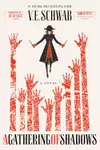

Compared to its predecessor, [b:A Darker Shade of Magic 22055262 A Darker Shade of Magic (Shades of Magic, #1) V.E. Schwab https://d.gr-assets.com/books/1400322851s/22055262.jpg 40098252], A Gathering of Shadows is paced much more slowly, and yet provides an infinitely deeper look into the world of Red London. The descriptions of place are so vivid it's easy to become immersed, and the sheer depth of Schwab's creation - languages, geography, history - are impressive without being distracting (you know, like some fantasy books that are more vehicles to show off worlds than narratives).I found this book more compelling than the first in the series; I think I felt closer to the characters. (Love ya, Captain Alucard.) However, while I felt A Darker Shade of Magic never lagged, I felt that this book sometimes did. The Essen Tasch (Element Games) in particular seemed to have a bit too much page time. Not way too much page time, just a bit.Overall, A Gathering of Shadows has enabled me to fall in love with this world and its characters. Bring on the finale!


This is a compelling story about a part of history that I knew very little about before I began reading. That said, parts of it were better than others. I was debating with myself whether to give it five stars, but I had just a few niggles - a few poorly-written passages, a subplot that seemed completely pointless, and a climax that wasn't particularly climactic. However, this was very worth reading for its account of Turkish diplomats in Nazi-occupied Europe, and the lengths they went to to save their citizens from harm. I'm not sure how much of it is embellished, but the story told here is fascinating and well worth reading.


See's books are always really enjoyable, and this is no exception. If you've read ‘Shanghai Girls', it's almost a requirement to read this. It's very different, being set in Maoist China instead of the US, but just as historically rich. See offers us a fair and critical view of this period of Chinese history, with an afterword somberly informing us that 45 million people died in the Great Leap Forward, at best estimate. It's also refreshing to read a novel that doesn't shy away from mentioning “feminine hygiene”.


The premise of this book - the idea behind the city-state of Easton - was pretty cool. I feel like this is the kind of book I'd have loved reading when I was about fourteen. It has a cool science-fantasy theme going, good-for-nothing government agents, and more. As an adult I appreciated the way it depicted the complete irrationality and melodrama of teenage love (I don't know if it was trying to or not, though). I have to say that some of the characters were better than others, and I was really disappointed with the trotting out of the “predatory lesbian” trope. Aside from that I think the teenage characters were very thoroughly teenage, to such an extent that I couldn't help but feel second-hand embarrassment for some of them (ahem, Rosalia).
I'm also not totally sure who the intended audience was. When I first opened it on my Kindle, the blurb had a section that went along the lines of “THIS IS AN ADULT BOOK WITH ADULT THEMES FOR ADULTS,” but thematically it was a pretty typical coming-of-age YA kind of a book, with very teenage characters who were not at all “mature beyond their years”. It just had lots of sex scenes in it. And really, what problem is there with teens reading that? The fanfiction they put out suggests they're pretty well acquainted with the idea. So, I would recommend the book to teens ahead of adults. The setting is really cool and deserves to be experienced, but I feel like the plot would appeal more to people younger than me.


This is the first book I've read in months that I've actually enjoyed reading and wanted to continue with. So, that's exciting. Unfortunately, I have to agree with some of the other reviewers' criticisms: many of the most important events in the book don't actually get scenes, but are referred to in passing after the novel skips forward in time. There is a lot of “telling”, rather than showing. Then sections of it seem like a sly wink at that “NYC academics who are also novelists” milieu, as if they were really the intended audience. (It's not as bad on this front as novels like [b:Americanah 15796700 Americanah Chimamanda Ngozi Adichie https://d.gr-assets.com/books/1356654499s/15796700.jpg 21519538], but just in parts...) This combines to make a novel that is nice to read, but once you finish you realise it didn't really have much of a plot. I vastly preferred [b:The Lowland 17262100 The Lowland Jhumpa Lahiri https://d.gr-assets.com/books/1366930267s/17262100.jpg 23858897] and recommend it to everyone who is considering reading this!


I bought this for less than $2 when I urgently needed something to read on the train. Unfortunately I lumbered myself with a slow and melodramatic monster for three months. Actually it did get better in the latter two-thirds (enough for it to be bearable to read, at least) but I never really got to the point of liking it. The main character was totally incomprehensible and a lot of the other characters weren't really that likeable, or didn't have enough substance to get invested in. I'm glad this is over.


One concept that appears in this book is “knacking”, a form of magic in which an object makes sense to everyone as something else. An example given is that of an underused meeting room door next to a toilet in an office; if a worker should notice its existence they would remark to themselves how strange it was that they'd never noticed before, then go on to never notice it again. They might notice a sign on the door saying something like “out of order”, or something else — something the effect of which was to say “not here, go somewhere else”.
Well, I felt that this book had been “knacked” with the same effect. I struggled to concentrate on it; my thoughts were always going elsewhere. There were a huge number of characters and I struggled to remember who they all were. I struggled to follow what was happening. It just ended up very confusing which is sad because it seemed to have some interesting ideas.
This book surprised me. It is horribly cheesy and melodramatic. The entire romance between Fleur and Hugh was so overwrought and read like bad fanfiction, and left me embarrassed to read this book on the train in case someone looked at the screen and noticed how turgid the prose was. It is also the worst-edited book I have ever read; it was so bad that I had to do a little investigation into the publisher, which seemed to me little more than a vanity publisher (if only for agented) books. They do not edit. It's obvious. In this book, ellipses are never limited to a mere three dots and there are serious issues with quotation marks. The punctuation is atrocious.
And yet in spite of all of that, unbelievably, I found myself completely unable to put down the second half of this book. I don't know how it happened. Maybe the author cast a magic spell. Who knows. But instead of rating this one star like I'd initially intended to, I have to give it three because I can't remember the last time I was so enthralled by a book (although this might be because I've been reading less this year). It was so suspenseful! And the ending, while initially unexpected for me, was very befitting of the book. $1.50 not too badly spent...


This is a nice little book, aimed I guess at pre-teens or young teenagers, with a gay 13-year-old main character and a mediaevalesque fantasy setting.
It did strike me as a very naïve book. The feudal society depicted is somehow undergoing dramatic social changes, such that women can go to school and become warriors (even against the wishes of their fathers) now, and in many contexts such as those Gibben Nemesio experiences, commoners can be treated the same as the noble-born. Despite being a poor and initially illiterate peasant, he makes friends entirely with high-born people, including a prince! With a little bit of sociological knowledge it's hard to see how such social changes could be occurring without the very foundations of feudalism being shaken, even a little bit. It's like if a reformist decided that never mind capitalism, feudalism was fundamentally an okay system that just needed a few reforms to make it “fairer”. It's still a nice, feel-good kind of book, but it's not very realistic in that way.
Also, I felt a bit too old to read about a 13-year-old boy's first boyfriend. It didn't help that they were really melodramatic about it all, either.


I enjoyed this book more than the last one I rated two stars, but honestly... this is a fluffy novel with poorly-defined characterisation and some really cringeworthy dialogue (the unrealistic misinterpretations of what people had said, mostly). It's OK to read if you have nothing else, but otherwise I'd prioritise other books.


For me this novel treads a lot of the same ground as [b:China Dolls 18404427 China Dolls Lisa See https://d.gr-assets.com/books/1405290827s/18404427.jpg 26038319] (except that China Dolls was actually published later, even if I read it before), but is a lot more mature. It takes place in the same time period, also focuses on the Chinese community in California, and both novels discuss (to varying degrees) the Japanese invasion of China and Chinese involvement in the US entertainment industry. So, if you like one, you will probably appreciate the other.As I implied, I preferred this one. While the novel begins with Pearl (the narrator) and May (her sister) being young, immature and carefree in Shanghai, the narration “grows up” sharply as Pearl does. There is a lot less stupid “boy drama”. While I gave China Dolls four stars with some reservations, Shanghai Girls has fully earnt them.


If you like retellings of fairy tales, you will probably like this. I certainly enjoyed reading it, but by the time I was getting to the end I had some reservations.
The main problem I had with the book was that there was no real causality. It was dreamlike in that way. If something bad happened, you didn't have to worry, because ~~magic~~ would set things right again in some unforeseen way. The characters were paper-thin, too, so it was impossible to get invested in the narrative. The saving grace was that it was easy to get swept along by the words.
I love Shaun Micallef on TV so I was expecting great things from this book, but it didn't deliver. I'm not sure why; its humour was absurd and deadpan. I feel like it might be because the book wasn't actually very political, despite the topic, and relied a bit too often on “LOL, sex, funny!”
The appendices at the end were funnier than the main content of the book, though. They bring this up a star.


Apparently this is Vonnegut's first novel, and of those of his I've read so far it's by a long margin his best. It's the only one with characterisation deep enough to get invested in anyone's storyline. It has some really funny satire of corporate culture.
It includes a pertinent and important critique of capitalism, in the sense that increasing levels of mechanisation should liberate humanity from increasing amounts of unpleasant work (which is what the ruling class here claims has happened), but under capitalism this is impossible, because you need money to pay for life's necessities and the only way to get it is by working – pretty hard, when almost all the jobs are being done by machines! While under socialism you would have the ever-decreasing amount of work being shared between everyone capable, under capitalism you get a steadily-growing group of unemployed workers, who are therefore destitute. Vonnegut's protagonist, Paul Proteus, gets a little misdirected and blames the machines themselves instead of the economic system, but you can easily identify the real problem ;)
The novel is really weak on the inclusion of females; it seems that almost every woman is a housewife (presumably because there are not enough jobs for even just a fraction of the male population...) but not actually everyone because Paul's secretary is a woman. At any rate, it seemed bizarre that a novel so concerned with how men should spend their lives would just ignore women completely.
While that was unsatisfying, I really enjoyed this overall. As you can see, four stars.


The light-hearted, cheerful tone of this book belies the content, which is (in many parts) very dark. It deals with the serious issue of how our society treats animals; it also has a lot of comic relief that prevents this book becoming simply depressing. Overall, I thought it was brilliant, although if you don't care about animals then the entire point of the book will be lost on you.