
Shane M.


Please see and re-read the reviews previously written for each separate individual volume in this (5) book collection. Needs no intoduction whatsoever.
Please see and re-read the reviews previously written for each separate individual volume in this (5) book collection. Needs no intoduction whatsoever.

Initially published as two volumes, here we have. all-in-one w/ "ART TO CHOKE HEARTS" & "PISSING IN THE GENE POOL" yet more pernicious, pendantic, and even at times. presumptuous pontificationns from the fastidious former frontman of the. band BLACK FLAG.
If anything truthful ought to be discerned from American society and its materialistic, maleficent, misogyninistic manifestations, one may turn to any essay in this book and find ample evidence for elucidation with the above content.
Initially published as two volumes, here we have. all-in-one w/ "ART TO CHOKE HEARTS" & "PISSING IN THE GENE POOL" yet more pernicious, pendantic, and even at times. presumptuous pontificationns from the fastidious former frontman of the. band BLACK FLAG.
If anything truthful ought to be discerned from American society and its materialistic, maleficent, misogyninistic manifestations, one may turn to any essay in this book and find ample evidence for elucidation with the above content.

The first in a series of. novels featuring Caitlin Strong, whose former partner was killed alongside her in a battle along the Mexican border involving drug traffickers, forcing her to terminate employment with the Texas Rangers, while at the same time learning the distinction of becoming the very first female Texas Ranger altogether.
The first in a series of. novels featuring Caitlin Strong, whose former partner was killed alongside her in a battle along the Mexican border involving drug traffickers, forcing her to terminate employment with the Texas Rangers, while at the same time learning the distinction of becoming the very first female Texas Ranger altogether.

Author David Bischoff has deservedly "hit the robot on the head" with the publication and advent of this novel published over twenty years ago. Broadly reminiscent of Philip K. Dick's own wildly inventive forays into unreality, viz; "The Simulacra," "We Can Build You," "Do Androids Dream of Electric Sheep? (the same award-winning novel that inspired director James Cameron's cinematic extravaganza "Blade-Runner") and the shorter more existential short fiction "Imposter," along with "The Electric Ant."
Because the novel takes place in a Dwight D. Eisenhower High School, the plot twists and interactions between students and teachers alike (both friend and foe) will most certainly remind movie-goers and cinema buffs of an alien invasion cut from similar cloth, viz; "The Faculty." Going back further into the late seventies and early eighties are also the trope-filled and turgidly triumphant "Class of 1984" and its sequel "Class of 1994," (both theatrical releases which immediately when both "straight to VHS home video" and late-night "television syndication" sci-fi viewership markets, w/Pam Grier, Stacey Keach, and that "actor's everyman," Roddy McDowell.
Author David Bischoff has deservedly "hit the robot on the head" with the publication and advent of this novel published over twenty years ago. Broadly reminiscent of Philip K. Dick's own wildly inventive forays into unreality, viz; "The Simulacra," "We Can Build You," "Do Androids Dream of Electric Sheep? (the same award-winning novel that inspired director James Cameron's cinematic extravaganza "Blade-Runner") and the shorter more existential short fiction "Imposter," along with "The Electric Ant."
Because the novel takes place in a Dwight D. Eisenhower High School, the plot twists and interactions between students and teachers alike (both friend and foe) will most certainly remind movie-goers and cinema buffs of an alien invasion cut from similar cloth, viz; "The Faculty." Going back further into the late seventies and early eighties are also the trope-filled and turgidly triumphant "Class of 1984" and its sequel "Class of 1994," (both theatrical releases which immediately when both "straight to VHS home video" and late-night "television syndication" sci-fi viewership markets, w/Pam Grier, Stacey Keach, and that "actor's everyman," Roddy McDowell.

Here in this volume is the final and first posthumously published collection of short stories written by the late, great Philip K. Dick three years after his passing in 1982. Printed in 1985 as a Doubleday first edition hardcover.
Here in this volume is the final and first posthumously published collection of short stories written by the late, great Philip K. Dick three years after his passing in 1982. Printed in 1985 as a Doubleday first edition hardcover.
Added to listOwnedwith 3 books.


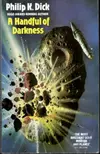
a.) A Handful Of Darkness: A UK story collection (What remains unique to the “digital editions” of this book is that the original “British English” (both in UK spelling and punctuation conventions) has been entirely substituted forthwith by American English altogether. Released in paperback by Panther Books (under the Grenada UK publisher’s imprint) “A Handful Of Darkness” (w/cover art by Chris Foss) was the first of many literary forays into the short fiction of Philip K. Dick which always by degrees of twists and turns, even to this very day, have left me altogether pleased, puzzled, and at the same time paranoid with both the audacity of both the audacity of Philip K. Dick’s own storytelling prowess, in combination with his felicity for never failing to find appropriate language to compliment the situations which any of his characters might find themselves in.
The stories in this edition were also rereleased as “Een Haindvol Diurentis” ( when reissued & translated into Dutch.) One of the two best stories here, (“Impostor”) was released as a movie by Walt Disney/Pixar al Studios, featuring Ed Harris (?) & Madeline Stowe in the “big screen” release. Both “Impostor” (and the short story “Colony” before it) deal with the psychological ramifications of both duplication and duplicity transpiring between both the protagonists and the environmental objects they manipulate, which, in turn, manipulate all unsuspecting parties to their end. In the story “Impostor” a planet is blown up (with the repercussions being that the human beings in this story ignore the warning signs that a schizoid simulacra lurks among them containing a bomb inside) while in “Colony” the “business as usual” approach for the native protoplasmic “life forms” of a “colony planet” invaded by Earth’s populace simply means there is never any hunger to be found, as the said “colony” of initial human conquerors is as easily destroyed as they are eaten alive.
a.) A Handful Of Darkness: A UK story collection (What remains unique to the “digital editions” of this book is that the original “British English” (both in UK spelling and punctuation conventions) has been entirely substituted forthwith by American English altogether. Released in paperback by Panther Books (under the Grenada UK publisher’s imprint) “A Handful Of Darkness” (w/cover art by Chris Foss) was the first of many literary forays into the short fiction of Philip K. Dick which always by degrees of twists and turns, even to this very day, have left me altogether pleased, puzzled, and at the same time paranoid with both the audacity of both the audacity of Philip K. Dick’s own storytelling prowess, in combination with his felicity for never failing to find appropriate language to compliment the situations which any of his characters might find themselves in.
The stories in this edition were also rereleased as “Een Haindvol Diurentis” ( when reissued & translated into Dutch.) One of the two best stories here, (“Impostor”) was released as a movie by Walt Disney/Pixar al Studios, featuring Ed Harris (?) & Madeline Stowe in the “big screen” release. Both “Impostor” (and the short story “Colony” before it) deal with the psychological ramifications of both duplication and duplicity transpiring between both the protagonists and the environmental objects they manipulate, which, in turn, manipulate all unsuspecting parties to their end. In the story “Impostor” a planet is blown up (with the repercussions being that the human beings in this story ignore the warning signs that a schizoid simulacra lurks among them containing a bomb inside) while in “Colony” the “business as usual” approach for the native protoplasmic “life forms” of a “colony planet” invaded by Earth’s populace simply means there is never any hunger to be found, as the said “colony” of initial human conquerors is as easily destroyed as they are eaten alive.

The perils and pontifications plausibly presented to a certain Jim Fergesson as he passively runs his auto dealership with all the preponderant passion and persuasion he can physically muster, month by month, week by week, and day by day within the obstinately onerus physical and psychological preplexities surrounding Oakland, California.
The perils and pontifications plausibly presented to a certain Jim Fergesson as he passively runs his auto dealership with all the preponderant passion and persuasion he can physically muster, month by month, week by week, and day by day within the obstinately onerus physical and psychological preplexities surrounding Oakland, California.